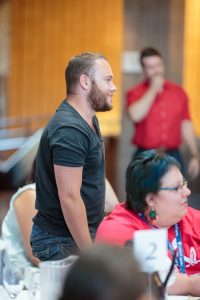
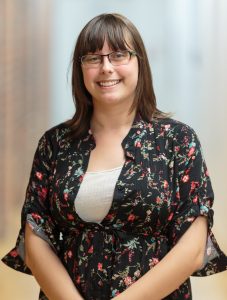
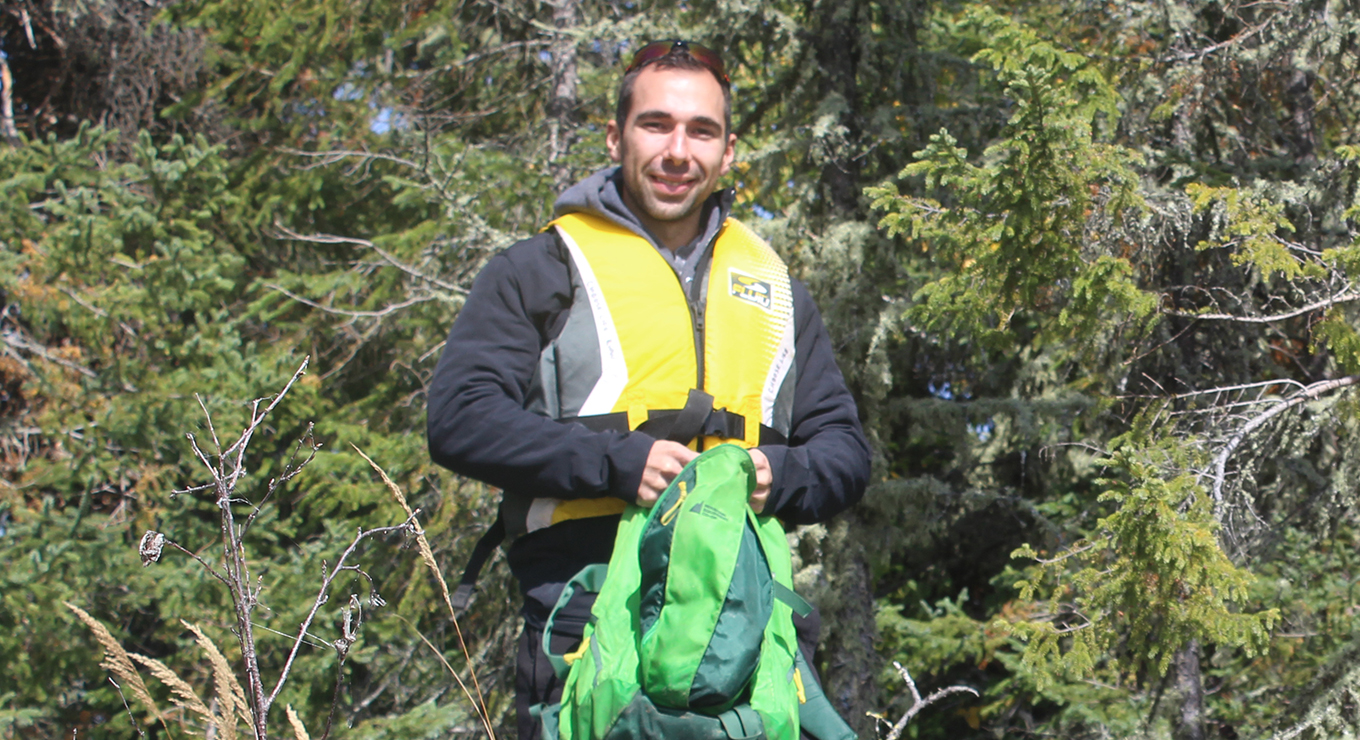
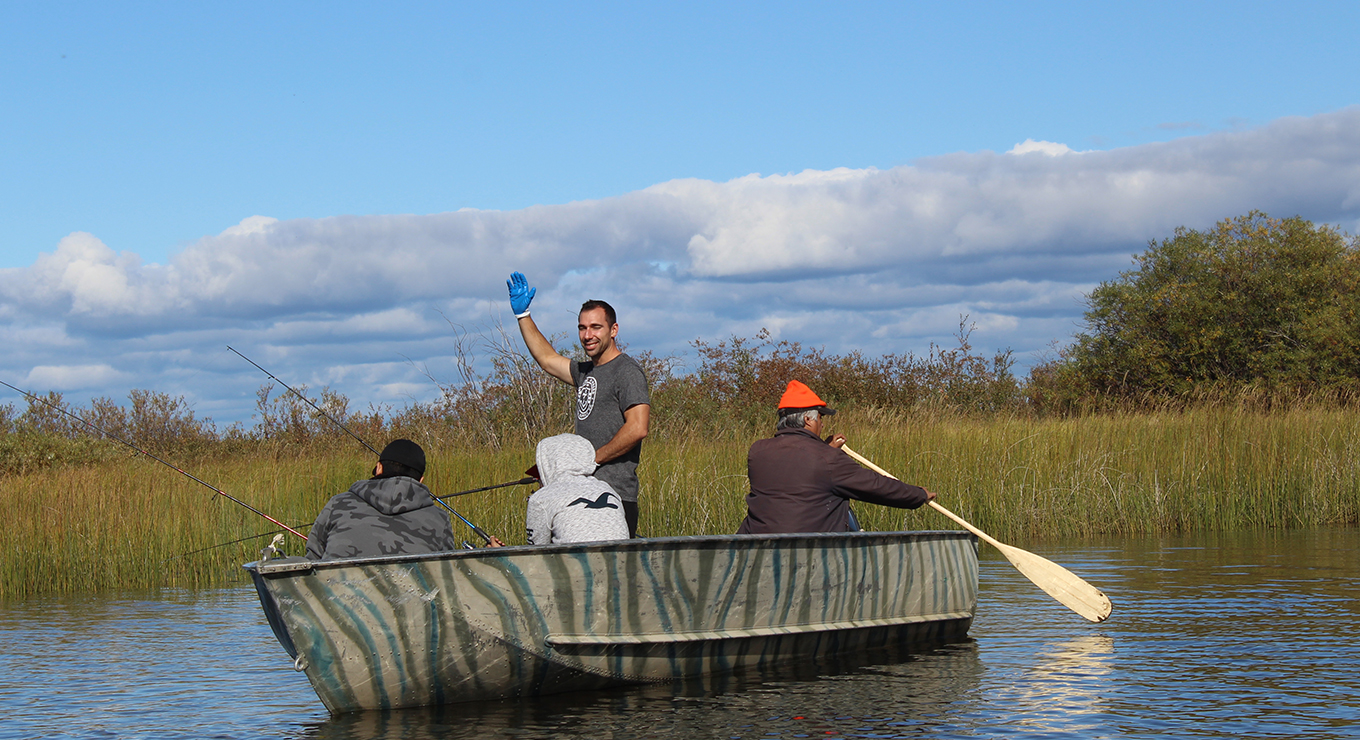
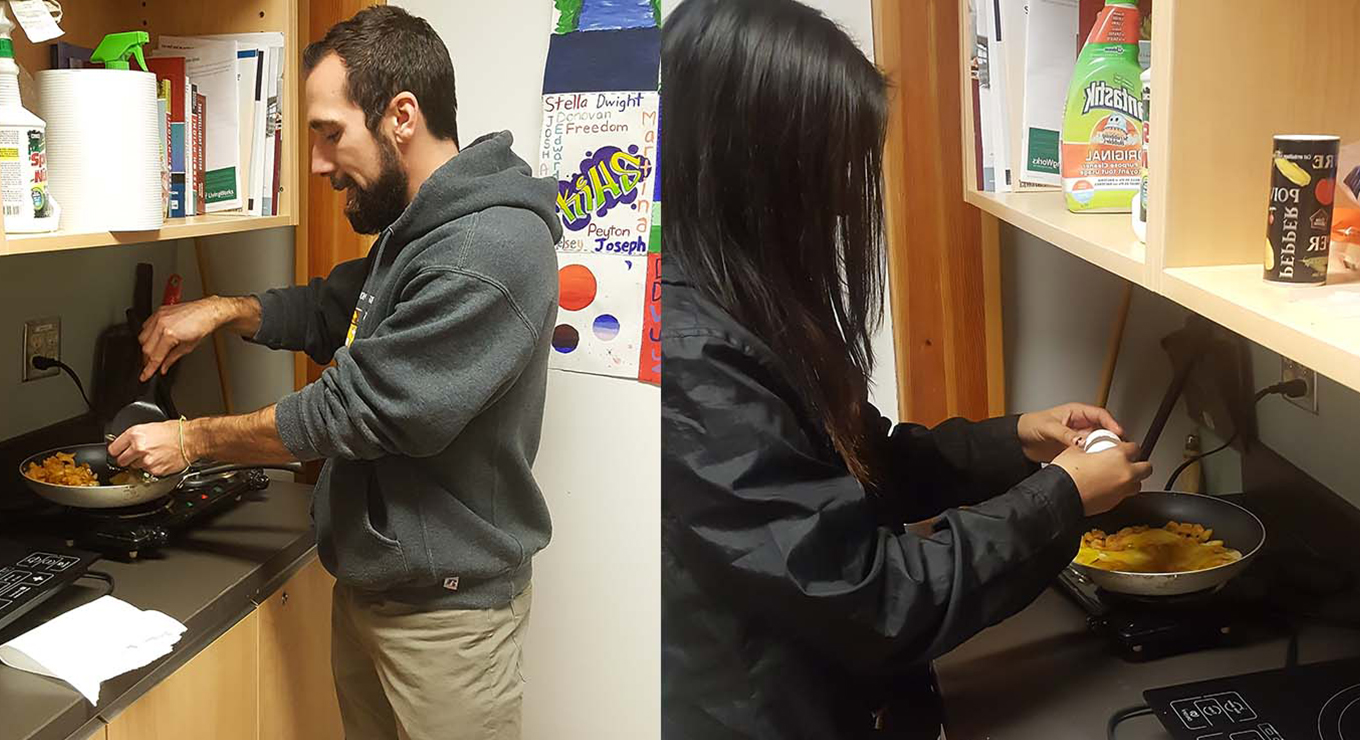
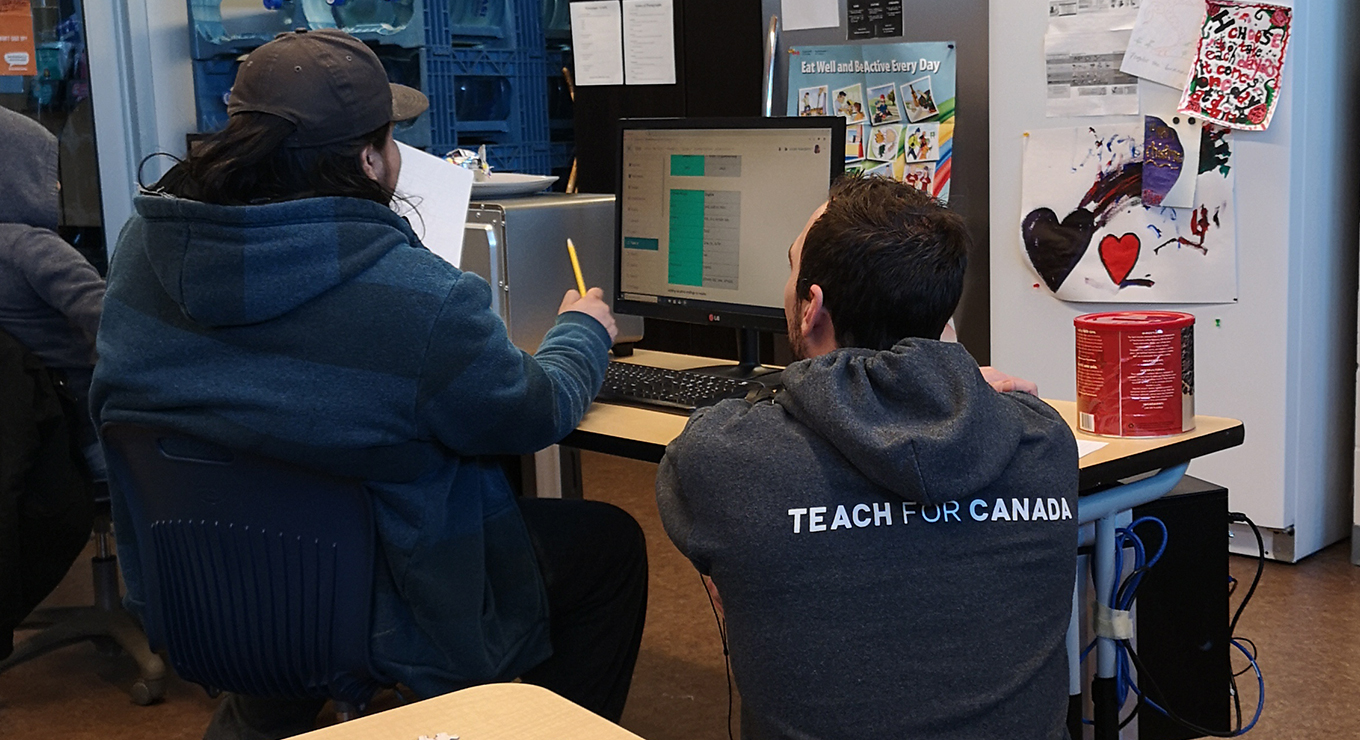
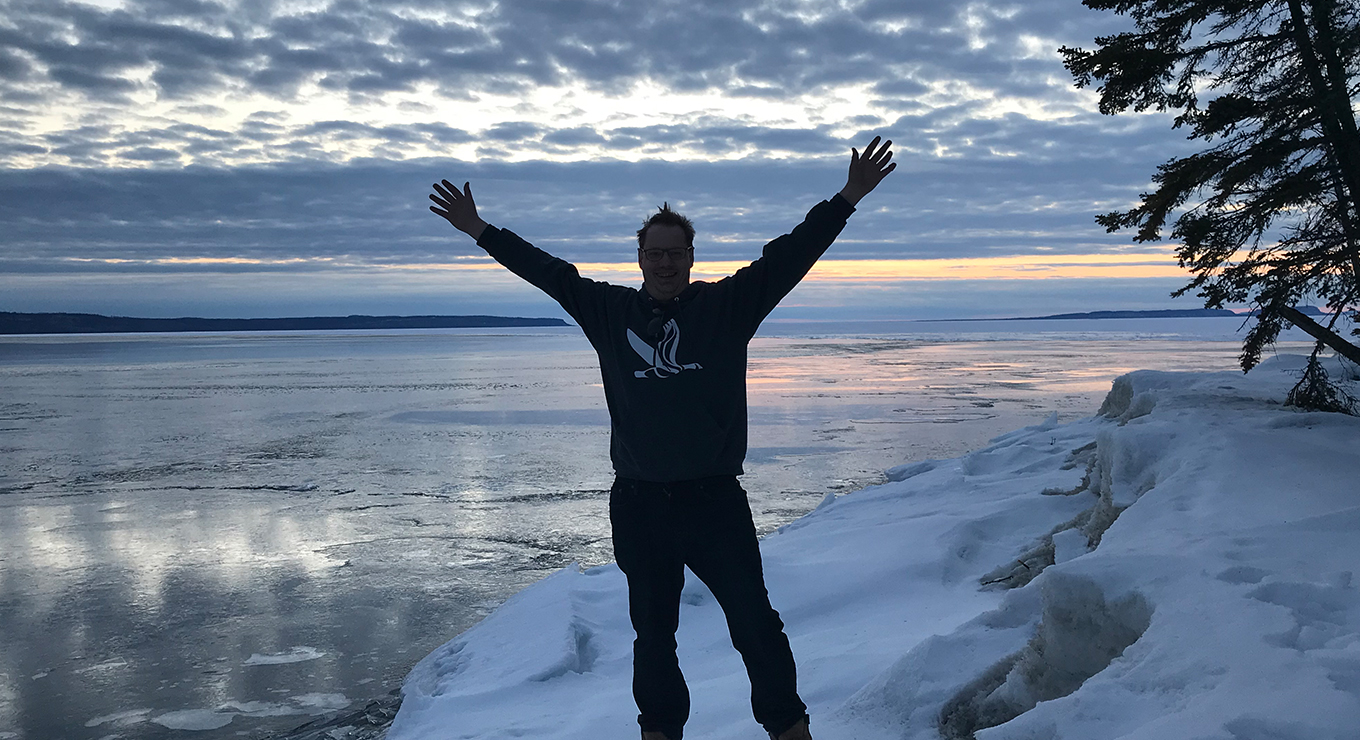
Christopher Johnson is a principal and kindergarten teacher living and working in Big Grassy River First Nation. He joined the 2016 Cohort of Teach For Canada and completed his two-year commitment teaching grades 3 and 4 in Big Grassy, making him a Teach For Canada alumnus.
Chris recently took on the role of principal at Pegamigaabo School and is being supported by Teach For Canada’s Administrative Preparation Program (APP), a new initiative offering northern principals wraparound personal, professional, and peer support, including monthly check-ins, bi-annual coaching, and resource support from an experienced practitioner.
Christopher Johnson joined Teach For Canada’s 2016 cohort and accepted a position teaching grades 3 and 4 in Big Grassy River First Nation.
On becoming a principal
Since becoming a principal, I think the most significant way in which I have supported Pegamigaabo School is through being present, organized, and looking ahead. I do my best to be as available as possible and make an effort to check in with my staff regularly. The world is uncertain enough as it is right now, so ensuring that my team stays up to date and aware of what is going on at school and in Big Grassy has been something I’ve stayed very mindful of.
So far, my role has provided me with a wonderful opportunity to learn new skills, which is something that I champion as an educator. I’ve been fortunate to participate in Teach For Canada’s Administrative Preparation Program, where I receive meaningful professional support from Admin Development Manager, Judy Blaney.
I believe that the most important aspect of my job is to ensure that the students and staff of Pegamigaabo feel safe and happy at school.
I sincerely hope that they do. I also want my teachers and staff to recognize how much I appreciate their efforts. Their continued commitment to our students and community has made the transition into my role much easier.
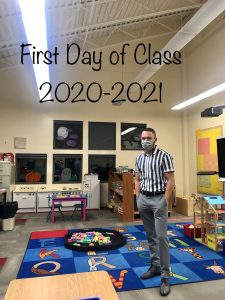
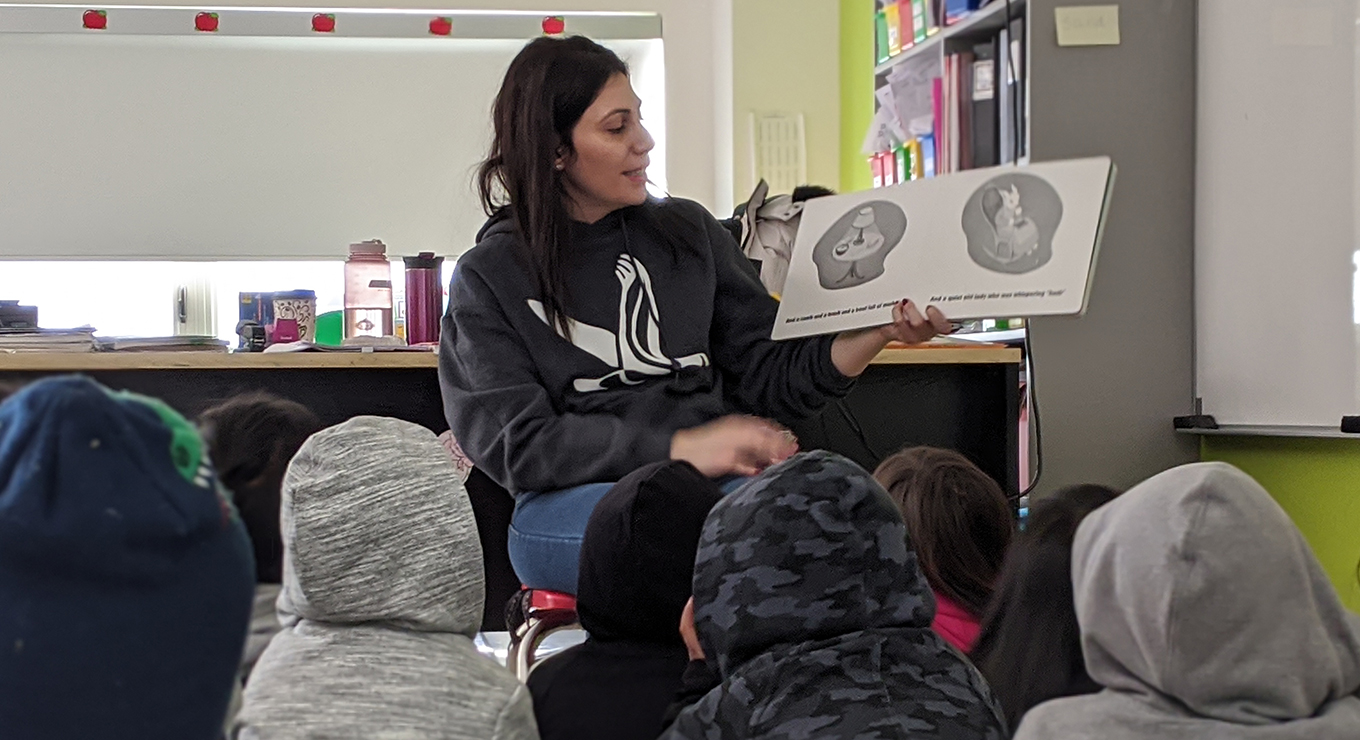
On top of being principal, Chris is the acting kindergarten teacher at Pegamigaabo School
On helping out in the community
It goes without saying that the pandemic has created a variety of stressors for us all, but I feel that as a team, my school has taken them in our stride.
Even when we’ve felt exhausted, we continue to work hard and to the best of our abilities.
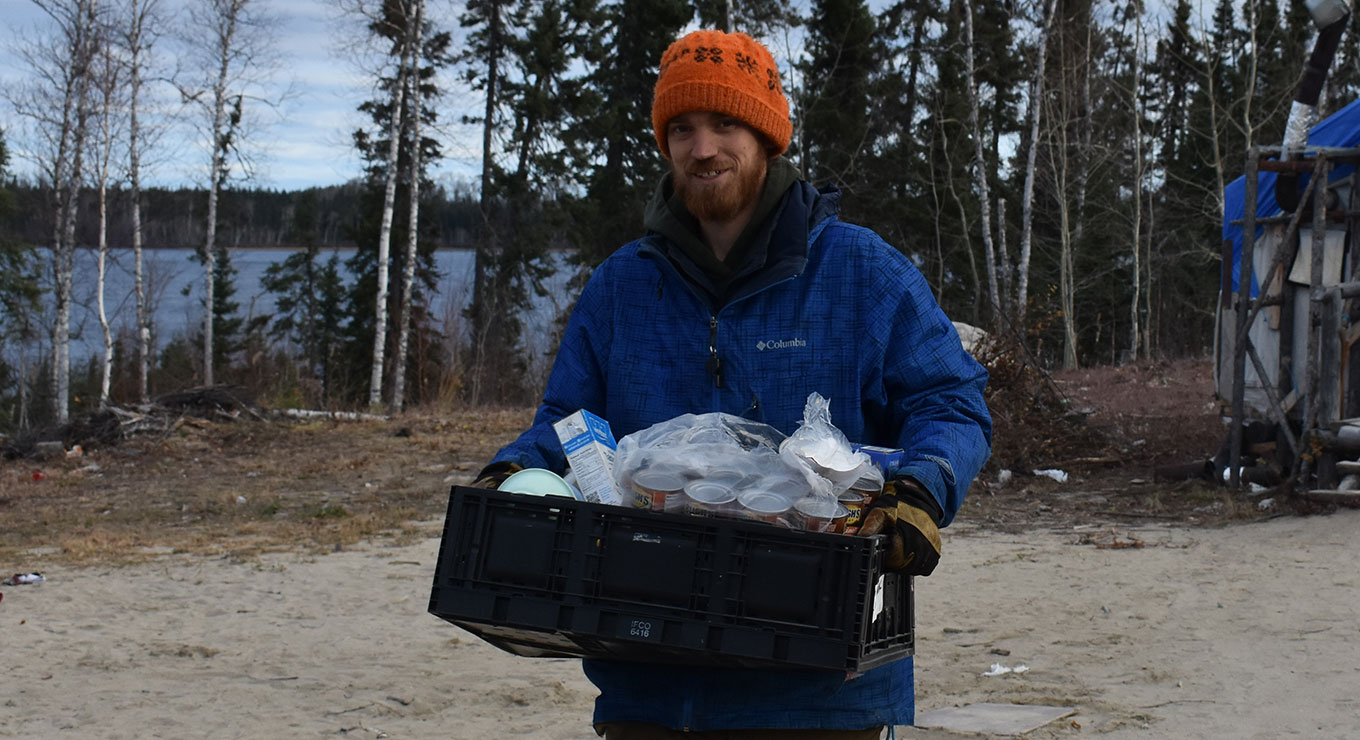
COVID-19 has offered several opportunities for my colleagues and me to strengthen our ties to our community. In addition to assembling, delivering, and assisting students with weekly schoolwork packages, we’ve taken shifts staffing community checkpoints, assisting with organizing and storing deliveries for the community food bank, and have dropped off weekly breakfast and lunch hampers to our students.
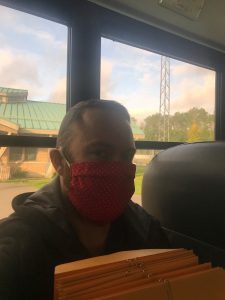
Chris and his teammates have assembled and delivered homework packages to students in Big Grassy throughout the pandemic.
Being able to take responsibility for the community has provided me with a sense of purpose during a period of ambiguity and constant change. I am very grateful for that, especially while being far away from my family and friends.
On some positive outcomes of COVID-19
Despite the challenges of the pandemic, some wonderful developments are happening in Big Grassy. I’m working with our Economic Development Officer to acquire a new play area for our school’s south playground. We’ve reached out to a few companies and will have some proposed designs to show the community members in the coming weeks. I would like for the students and their families to be involved in the selection process. In addition to the new playground, we’re hoping to install a small outdoor fitness area too!
Outside of school, some of the positive things that have happened this year have been being able to spend more time with my dogs, discovering a love of cycling, and getting way too into hula hooping.
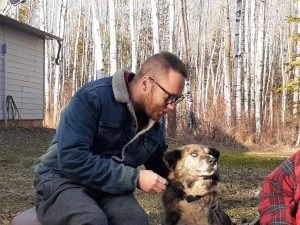
Chris and Shorty, a Big Grassy community dog who is known as the school’s unofficial mascot.
Interested in learning more about teaching in the North during COVID-19?Read our FAQ.
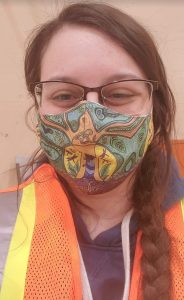
Janna Garrett is a grade 8 teacher in Kitchenuhmaykoosib Inninuwug (KI) First Nation, Treaty 9 territory. Janna is Métis and a member of Teach For Canada’s 2018 cohort. She completed her two-year teaching commitment at Aglace Chapman Education Centre, making her an alumnus of Teach For Canada.
Janna has lived and worked in KI since 2018, and has been working hard to make a difference in her community throughout COVID-19.
Janna is a grade 8 teacher at Aglace Chapman Education Centre.
After KI announced a school closure and community lockdown last year, I missed seeing my students each day. I struggled with feeling like I no longer made a difference in my community. When local staff invited me to sit in on a Pandemic Committee meeting, I was eager to attend and find some ways to get involved.
From then on, I became part of the Pandemic Committee crew, acting as unofficial secretary. As COVID persisted, I helped distribute packages of caribou meat to each home in our community. Once school reopened in October, I was able to return to teaching, but I continue to support the Pandemic Committee whenever possible.
Janna joined the KI Pandemic Committee, acting as secretary.
I’ve been fortunate to take part in helping community members and out-of-town staff register for their vaccines. I was able to support Operation Remote Immunity, an initiative launched to offer the COVID-19 vaccine to residents of Indigenous communities in remote areas, who face a disproportionate risk from the virus.
Through Operation Remote Immunity, I’ve had the opportunity to work alongside a talented team of medical professionals, kind Independent First Nations Alliance volunteers and local members of the Canadian Rangers.
Health Services team members are off to Kitchenuhmaykoosib Inninuwug! They will be administering 100 more doses of the Moderna vaccine today in partnership with the KI Pandemic Committee. pic.twitter.com/0LixysrFcW
— Independent First Nations Alliance (@ifnalliance) April 20, 2021
This year, some of the biggest challenges I’ve faced as an educator have been maintaining connections with students throughout repeat closures and promoting a positive atmosphere in school. When our classes resume, I do my best to communicate to my students how much I missed them.
“I want my students to know how much I appreciate them and our time together, and how much better my life is with them in it.”
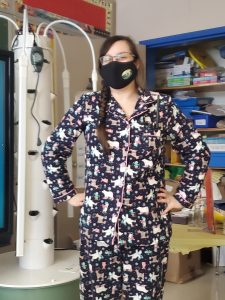
Our school has succeeded in organizing some school-wide activities and events to lift students’ spirits, including Crazy Hair Day, Decades Day, and my personal favourite, Pajama Day. Laughter has helped me stay positive throughout the pandemic. I try to find ways to laugh and smile with my students each day.
Janna and her students had fun dressing up for a school-wide Pajama Day.
“Even though COVID-19 has presented unique challenges in our school and community, I have found lots worth celebrating.”
I’m most proud of the resilience that my students have displayed throughout the last year. They approach every day with compassion and optimism. While KI has seen some challenging days, when I look back on the beginning of the year, I realize how far each of my students has come. Their individual growth, strength and abilities to adapt motivate me to be the best teacher and person I can be.
Interested in learning more about teaching in the North during COVID-19?Read our FAQ.
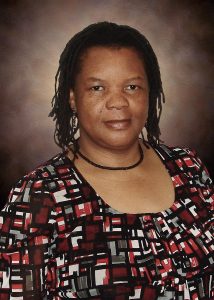
Melania Chikobvu is a Special Education Teacher in Sandy Lake First Nation and an alumnus of Teach For Canada. She completed her two-year commitment in Sandy Lake from 2018 to 2020 and continues to teach in the North.
Since the onset of the Coronavirus pandemic in March 2020, life in Sandy Lake First Nation has changed. Like many communities around Canada, the 2020 March Break was extended indefinitely. In our community, Chief Delores Kakegamic and her team worked tirelessly to put measures in place to curb the spread of the virus and protect residents.
Melania joined the 2018 Teach For Canada cohort and accepted a position from Sandy Lake.
Community protocols
In Sandy Lake, those entering the community were tested upon arrival, before taking part in a mandatory 14-day quarantine. Around the community, no visits or gatherings of any kind were permitted. As cases rose across the country and Toronto, Winnipeg, and Thunder Bay were declared red zones, Sandy Lake further tightened its restrictions. People who wished to leave the community first had to receive permission.
“Although these measures seemed strict at the time, I am grateful for the strong approach that Sandy Lake took. It’s because of these efforts and restrictions that our community has only seen a handful of positive COVID-19 cases.”
School adaptations
In October 2020, elementary through grade 8 staff transitioned to assembling homework packages to keep students engaged from home. Grade 9 and 10 teachers pivoted to conduct online classes.
By November, some school functions resumed with limitations. Classes were split in half, with one-half of students attending in the morning and the other in the afternoon. Even though some classes had resumed, the school felt different.
School schedules were reduced, with elementary classes meeting twice per week. Educator schedules also shifted to accommodate social distancing protocols. Teachers were no longer able to be in school together every day.
In Sandy Lake First Nation, in-class learning has seen lower levels of attendance due to COVID-19.
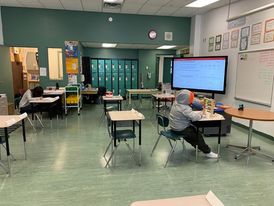
Classrooms that used to be alive and buzzing with energy had become emptier, exceptionally tidy, and were frequently sanitized. The corridors were quiet. Because some parents chose to keep their children home, attendance decreased. As an educator, I found it challenging to engage fewer students when I was used to full classrooms. The change was especially evident with the cancellation of recess.
Homework packages continued to be delivered to students to make up for reduced in-classroom learning. Soon, we began offering prizes as incentives for students who completed their work. Throughout this time, the elementary school was being used as a distribution center for the vaccine.
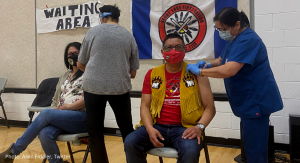
Grand Chief at Nishnawbe Aski Nation and a member of Muskrat Dam First Nation, Alvin Fiddler shared this image on Twitter April 6th, 2021, with the caption: “Delores Kakegamic and I got our second shot of the Moderna vaccine here in Sandy Lake. My sister Nellie administered it. One word to describe how I feel on this final week of Operation Remote Immunity – Grateful.”
Land-based learning
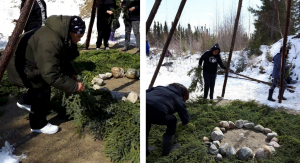
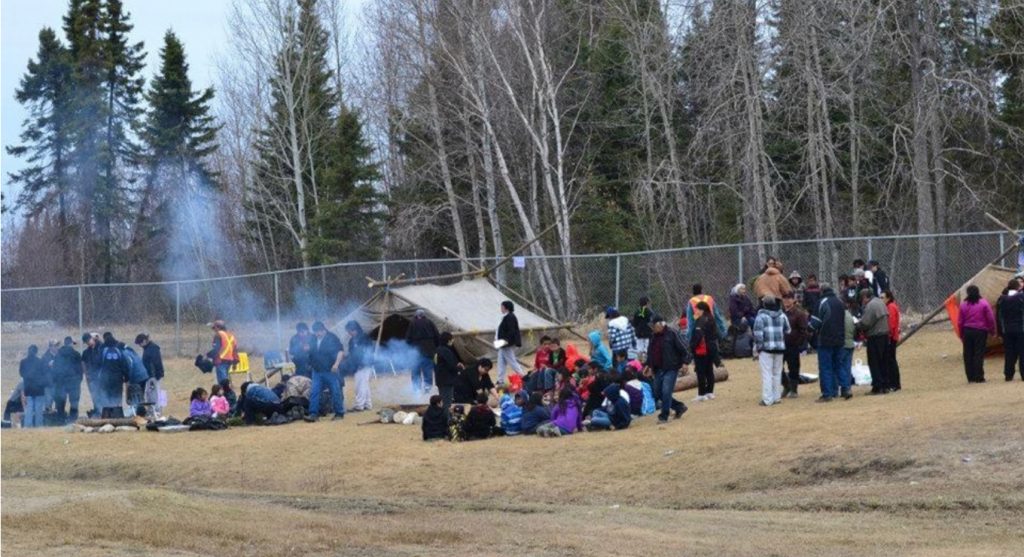
Land-based learning is generally a huge part of Sandy Lake’s curriculum. Teachers will often take students rabbit snaring, ice fishing, ice skating, camping, and on snowmobile rides. Winter brings fun outdoor activities, like snow carving competitions, moose hide treating, fish smoking, and tipi making. Indoor activities including filleting, beading, and bannock making are huge staples of our school and community.
Land based learning plays an important role in the Sandy Lake community.
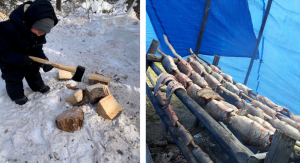
A young member of the Sandy Lake community learns to chop wood. Fish is smoked over a fire.
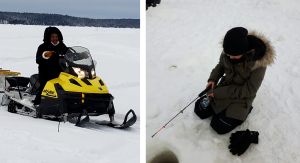
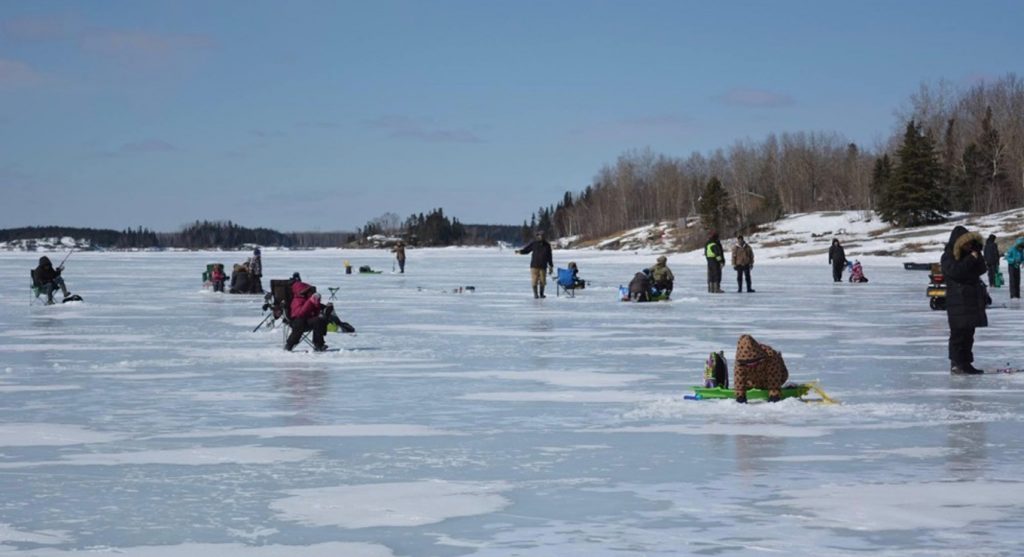
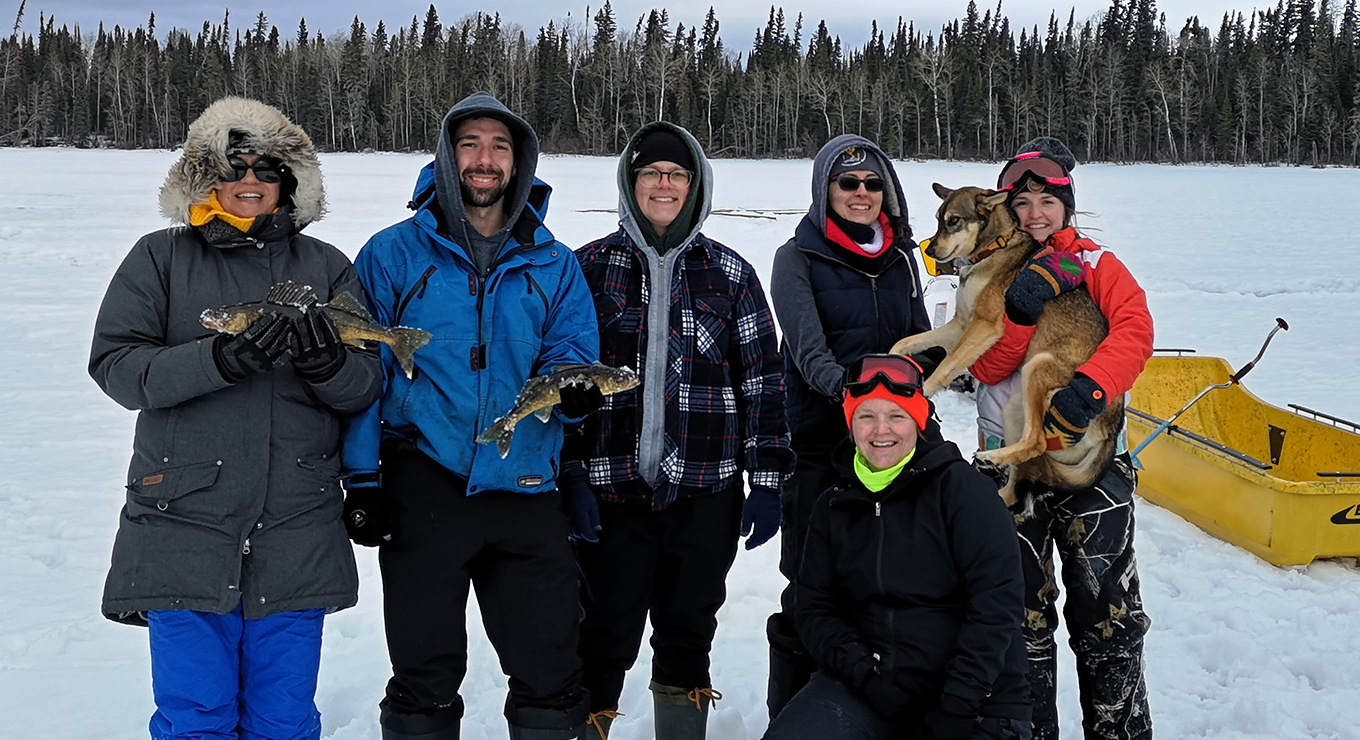
Sandy Lake’s big annual event, the February Lil Bands Hockey Tournament, typically engages nearly every family in our community. This year, many of the event’s activities were impossible under COVID regulations. Luckily, we were approved to take part in some, like snowmobiling and ice-fishing.
Socially distanced outdoor events, like snowmobiling and ice fishing, were permitted during COVID-19.
Departmental changes
Some changes that resulted from COVID-19 were specific to the special education department. Programs that usually brought therapists and assessment teams into our school were suspended. Thankfully, we could still offer speech and language therapy sessions and psychoeducational assessments virtually.
Takeaways
Teaching in the North during COVID-19 has its challenges. Some days, it has felt overwhelming not knowing what the next day holds. As a teacher, I have had to plan with the knowledge of no guarantees. I am always aware that my lessons and programs may be postponed or canceled at a moment’s notice.
I am grateful for Teach for Canada’s support and the access to mental health resources they provide. Through Teach For Canada, I can access personal support, like counseling sessions as well as professional support and direct mentorship from my Teacher Development Manager, to help me through these difficult times.
Taking things day by day has really helped me through COVID-19. As a remote community, Sandy Lake has faced additional challenges, including water shutdowns, power outages, and internet issues.
Through it all, the people of my community still laugh and smile. We know we will get through this together.
Interested in learning more about teaching in the North during COVID-19?Read our FAQ.
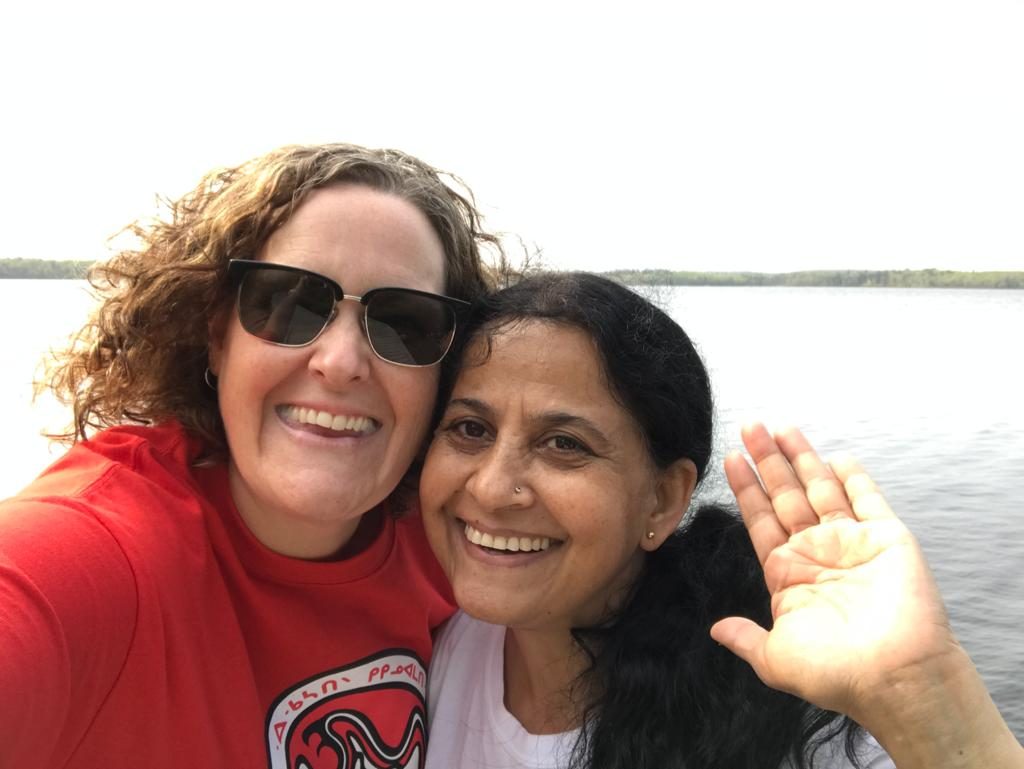
MarshaKing, a second-year Teach For Canada teacher living and working in Pikangikum First Nation, writes about her friendship with Meena Prabhakar, a second-year Teach For Canada teacher also based in Pikangikum. Marsha highlights how their friendship began at Teach For Canada’s 2019 Summer Enrichment Program and has continued to grow in their time teaching side-by-side.
Teach for Canada has given me so much— cultural training, a foundational understanding of Indigenous Education, support for my classroom, access to mental health resources, and tons of additional help (which has been invaluable while working through COVID-19). Out of all these things, the greatest gift that Teach for Canada has given me is Meena Prabhakar, my friend.
Meena and I met in July 2019 at the Summer Enrichment Program (SEP) before we moved north. During the three-week training, we connected, spent time together and learned more about each other. At SEP, through the workshops, meaningful teachings, and downtime, we planted and nurtured the seeds of a friendship. To this day, our relationship has continued to blossom, as we work side by side in Pikangikum. I know that my friendship with Meena will grow long beyond our time with Teach For Canada.
Marsha and Meena met at Teach For Canada’s Summer Enrichment program in Thunder Bay, 2019.
On the outside, the two of us might not have seemed compatible. She is Hindu, and I’m Christian. While she is married with children; I am single with no dependents. Meena is a vegetarian and I eat meat. I grew up in Canada and speak only one language; Meena grew up in India and speaks many. I am tall and Meena is short. But somehow, we just work together.
Over the past two years, Meena has become one of my closest friends in Pikangikum.
We often share meals, go to church, and engage in social activities together. My favourite activity to do with Meena is take our frequent walks. It’s on these walks, spent winding around Pikangikum, where I’ve learned so much about her family, life, and the heart of who she is. If you ever meet Meena, you will understand that her heart is awesome.
2020 was a year like no other. When COVID struck in March, Meena and I would find ourselves going on daily walks to combat the loneliness and isolation that came with being cut off from our family and friends down south. We became each other’s support system— a place to get a good hug when we needed it.
As I adjusted to the unpredictability of COVID-19, I also took a new role at the school, as Learning Resources Coordinator. It was not an easy job to transition into in the heart of a pandemic, and my schedule as a Department Head was constantly shifting. Every morning, Meena would pop by my room to say a quick hello. She’d take the time to make sure that I was doing okay. And when my mental health plummeted, Meena was the one to walk alongside me and give me the space to remember that I was more than my work.
There have been times when Meena’s generosity has been so overwhelming, I could cry.
We are sisters of the heart in so many ways and have become like family. I have the phone numbers of her loved ones at my fingertips and the knowledge that I am welcome into their home at any time.
Teach for Canada has given me so much and I am certain that, had we have not had the time at SEP to build a relationship outside of our busy school schedules, Meena and I might not have become so close. We could have very easily missed each other in our differences.
I am grateful for every gift that has come my way from TFC, but some of the best gifts are the ones that can’t be wrapped— like my friend for life, Meena.
Heather Mason is a vice principal in God’s Lake Narrows First Nation. God’s Lake Narrows First Nation is located in Northern Manitoba and has a population of approximately 3,000 people. It is a fly-in community with ice road access from January until March. We asked Heather common questions educators have when considering teaching in the North.
Heather was recognized one of CBC’s Manitoba Future 40 and previously received the Outstanding Women Award from Brandon University.
1. What is your role in the community?
My main job at the school as vice principal generally focuses on discipline of students. Luckily for me this year COVID has reduced the number of students we have in the building so my job has been pretty easy in that regard. We hardly had any behavioural issues to deal with at all in the last 2 months, so that has been really great.
It’s actually my first year as an administrator. I just recently finished my masters degree in administration so I’ve only been an administrator for 2 months. I write a weekly school observation letter where I address positive things that are happening in the school and a monthly newsletter. Some more formal parts of my job include tracking inventory, maintaining social media accounts, creating schedules for support staff, dealing with daily operations in tandem with the principal, and anything that happens to come up during the day.
2. Prior to COVID-19, what did a typical school day look like?
Our staff arrives at 8:00 am in the morning which gives them around 45 minutes of preparation time before the students come in at 8:45 am. Our day starts at 9:00 am. The average class size is 20 students. 23 is about as large as any class gets. Lower grades have almost perfect attendance until Grade 7, 8, and 9 and then the numbers start to fall off for a variety of reasons. We have a full hour lunch break and two 15 minute breaks for students to go out for recess.
3. What do things look like right now with COVID-19?
Our community has taken it very seriously since day one. We are discouraging gatherings of more than five people. We can’t have extracurricular activities right now since we can’t guarantee student safety. For our school schedule, we have classes rotating on a Day 1 and Day 2 basis. Half the class comes on Day 1 for a full day and the other half comes on Day 2 for a full day. To avoid burnout we have dedicated Fridays as a sanitation and assessment catch up day for teachers that are doing homework packages and sanitizing their classrooms.
We want to make sure that teachers are not feeling completely overwhelmed. We are offering both in class sessions and distance education for students whose parents are uncomfortable with sending their children into the building. Teachers are splitting their time doing a lot of jobs and we wanted to support them that way.
A lot of our students are interested in sports and video games. Social media is unfortunately really big with students right now. Our school only goes to Grade 9 so students leave when they are about 14 years old and are then flown to another city like Thompson or Winnipeg. They finish their high school education in another community which is not ideal. That is why they are building a new school in our community. We will eventually be able to run all the way to Grade 12 in the next year or so.
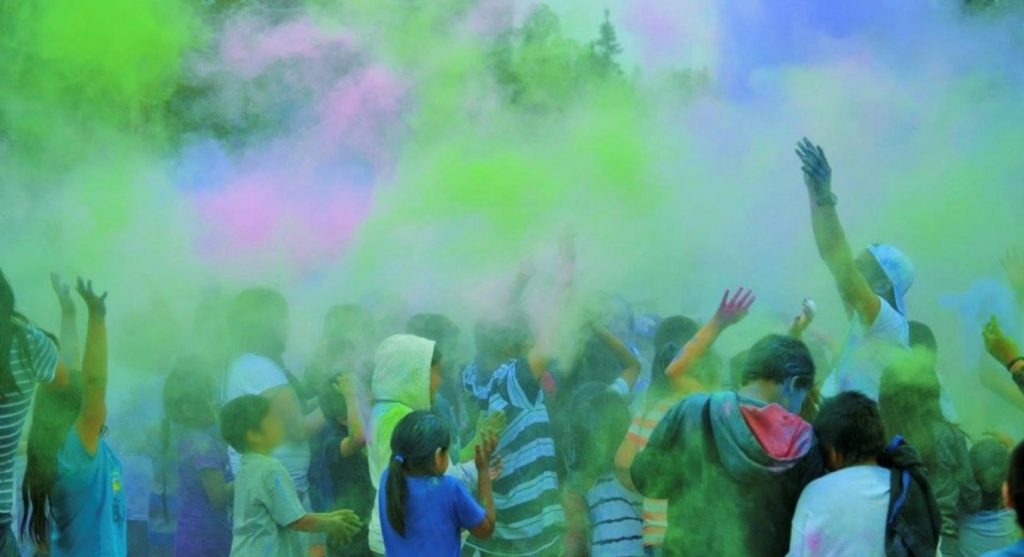
Heather organized a run or dye colour run where participants threw coloured powder at one another at the end of the 4km race. It was a very successful event and a great way for the school to bond.
It is a bit higher than the South. For instance, a gallon of milk will cost you about $7, a bag of potatoes is around $2 down South and about $7.99 up here. So you are paying sometimes double or triple what the cost of food is down South. However, our rent is reduced and subsidized to help with living costs. You pay about 300$ max for a 3 bedroom unit, including hydro, which is pretty decent I think.
6. Would being a vegetarian be a challenge?
I think a vegetarian would do well. Our food access is a bit limited — our grocery store is small. However, they do offer a consistent amount of fresh fruits and vegetables so you would not have to worry about that. There are also a lot of frozen vegetables.
7. How long is a teacher’s commute from home to the school?
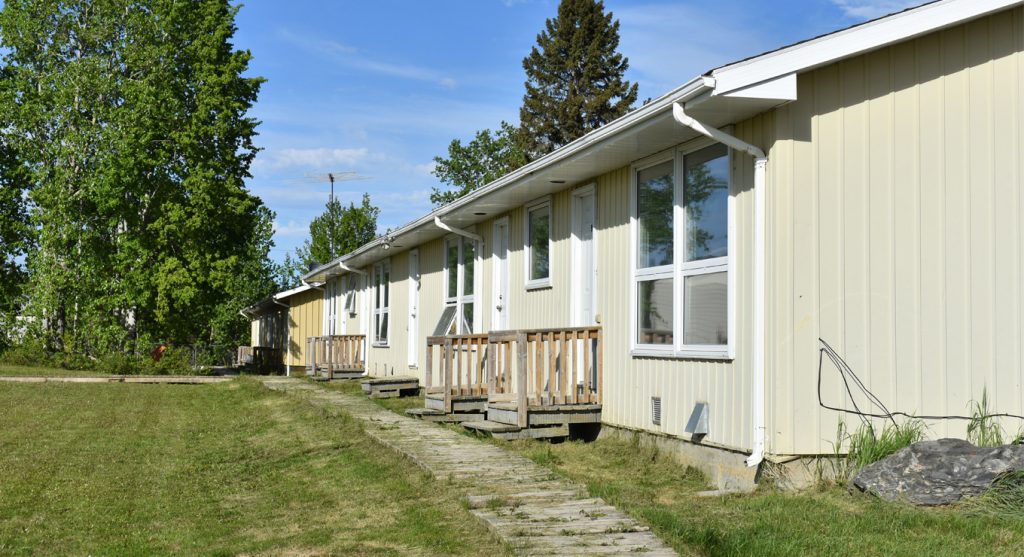
If you could throw a baseball pretty far, you could hit the school from your house. It’s about a one minute walk. That makes things a lot easier for everyone, especially in the winter. Each teacher has their own unit and we offer a 1, 2, or 3 bedroom unit.
8. What sorts of activities are available for teachers in their free-time?
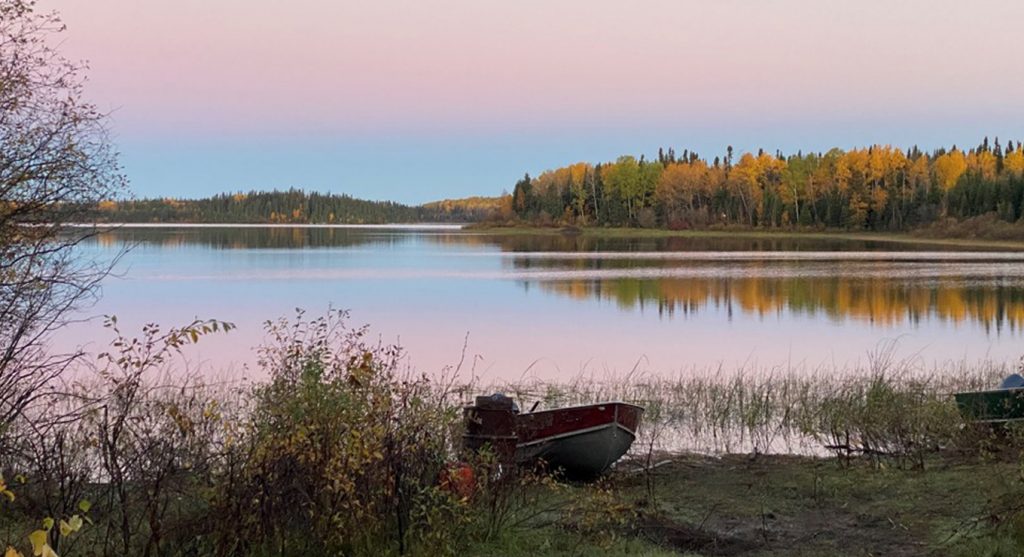
Prior to COVID-19, we had local hockey and volleyball teams that were pretty popular to watch. We have world class fishing if you are into hunting and fishing, hiking and snowshoeing, and arts and cultural events in town. You will have access to canoes and fishing boats. If you have a boating license, you are free to use that equipment. We have gatherings and bonfires in the staff communal area. There is a local fishing lodge in town where staff meet for dinners on the weekends. We have a gym facility for staff to workout in as well.
Fun fact — All the water in Manitoba runs north! Teachers can borrow and use boats similar to the one pictured above.
9. What would employment opportunities look like for teachers that apply with a non- teaching partner?
There are some jobs that anyone can apply for. We have a local RCMP station, a nursing station, and a local Northern store and sometimes people get work there. There are opportunities for custodial, janitorial, and security work. We have a large construction crew on site right now because a new school is being built so there will be jobs available for at least the next 2 or 3 years while that is being completed. Sometimes we hire partners for educational assistant work as well. It depends on the situation.
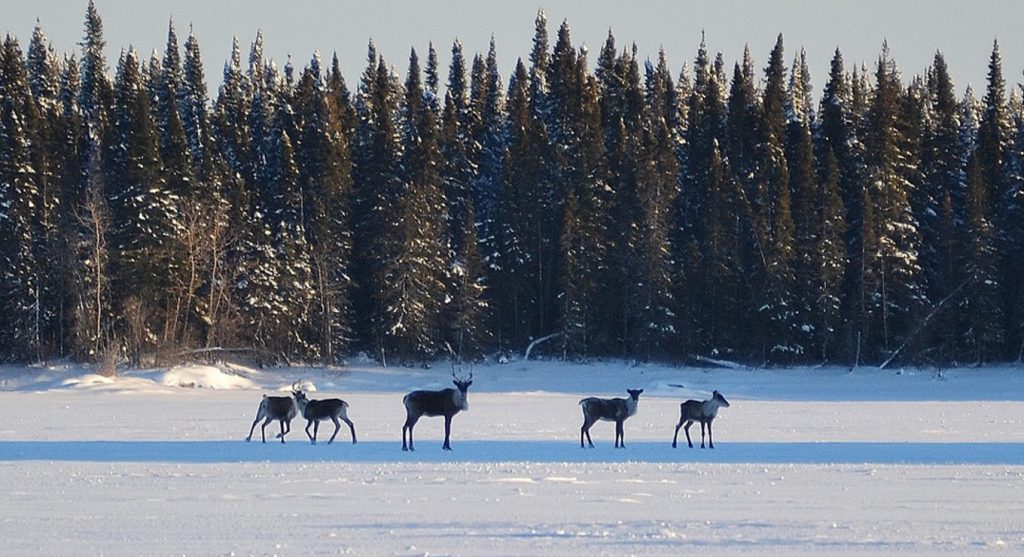
We do have bears, wolverines, moose, wolves, and other large animals around. Generally, everyone is very safe inside our community. If you’re out snowshoeing and out in the wilderness alone then we recommend that you take some weapon with you or bear spray. I have my hunting license so I bring my rifle with me, but that’s not common.You don’t have to do that. I spend a lot of time out on the land myself.
*Teach For Canada has rarely heard of negative teacher experiences regarding encounters with wildlife, but it is important to always be prepared*
11. What is safety like in the community?
I live outside of the school area. I have a house in the community and I feel very safe. If you feel nervous living in the teacher area, we have security for the evening hours up until 7 am in the morning. We generally have very few incidents that affect our school. I feel very safe here and I know a lot of the staff do as well. Most people aren’t concerned about that stuff.
12. How can teachers build relationships with the community and land, especially if they are unfamiliar with the culture?
God’s Lake Narrows is a very friendly community. We host a lot of events like: treaty days, musical events, and gatherings. These activities are outside of work hours so we really encourage you to meet others and to be active. Join some sports teams if you want and get involved in coaching. Coaching helps you to get to know the students better as well. Make a friend here and there and build your network. Don’t be shy to make friends in a new place. We know that everyone who comes here needs to learn and we are open to sharing.
We know it takes time for people to open up and learn those skills. As long as you are open minded and willing to jump in and learn then I think you will do just fine.
The town fishing derby — Teachers can get involved in the event and participants can win large prizes!
13. What are some challenges that educators may encounter with students, families, or the school?
Our number one challenge for our junior high students would be attendance and motivating them to come to school. I think they really need a lot of engagement in the classroom and when teachers aren’t providing that, students check out quickly. You have to be really mindful of that when you are teaching older students. You have to work harder for it I think.
14. Are there any particular strategies to encourage attendance or engage students in a better way?
I find that using more hands on experiential learning and outdoor learning experiences can really turn things around in the classroom. I think all too often teachers get stuck on worksheets and notebooks.
Learning can happen in all sorts of ways. Don’t be afraid to try something that is outside your toolkit that you wouldn’t normally use.
God’s Lake Narrows hosts a fall and spring cultural week where students learn how to prepare meat, make fires, and cook.
15. What advice do you have for teachers who are considering teaching in a Northern First Nation?
Be open and flexible. Research the community before you go so that you don’t have a fixed idea in your mind that gets disrupted once you arrive. That happens a lot. Do your best to check your European classroom idea and put that to the side. Try to incorporate as much culture as you can and make connections with the community. Making these kinds of connections will help reduce boredom and help community members and students to trust you.
Beatrix started her journey in Nisichawayasihk Cree Nation in 2020 as as a Grade 5 teacher. She and her husband Matteo, who is not a teacher, are both originally from Europe. Beatrix attended the Ontario Institute for Studies in Education (OISE) of the University of Toronto and aims to inspire her students through collaboration and hands-on learning.
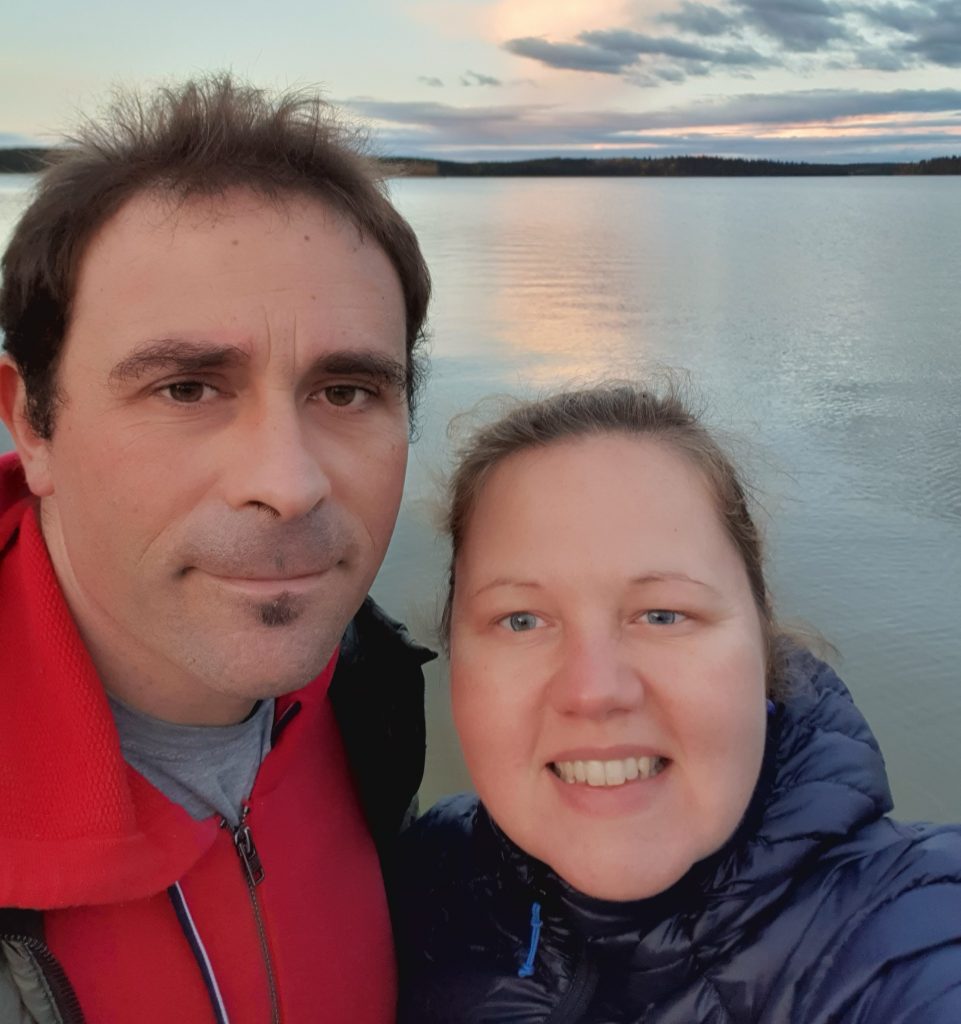
Beatrix and her husband Matteo.
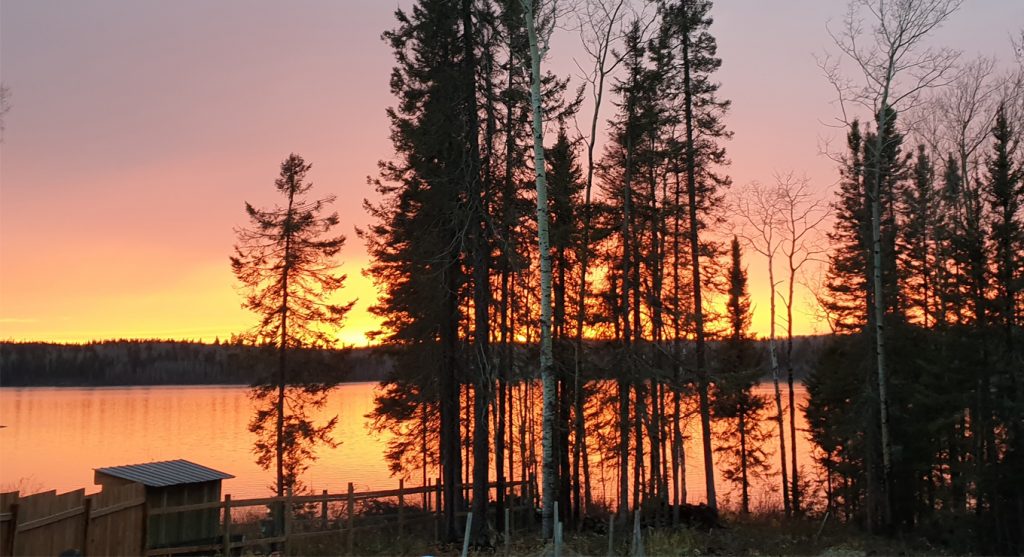
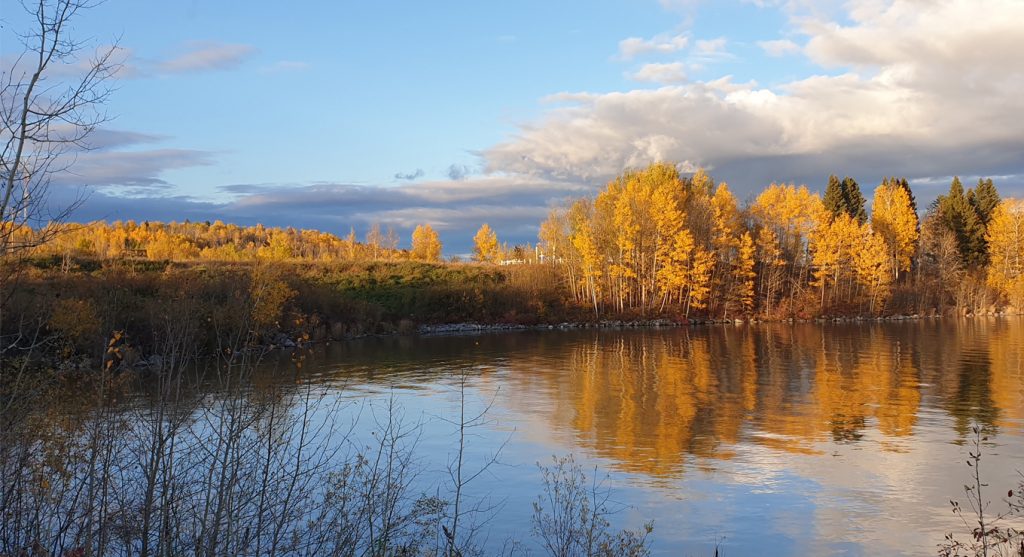
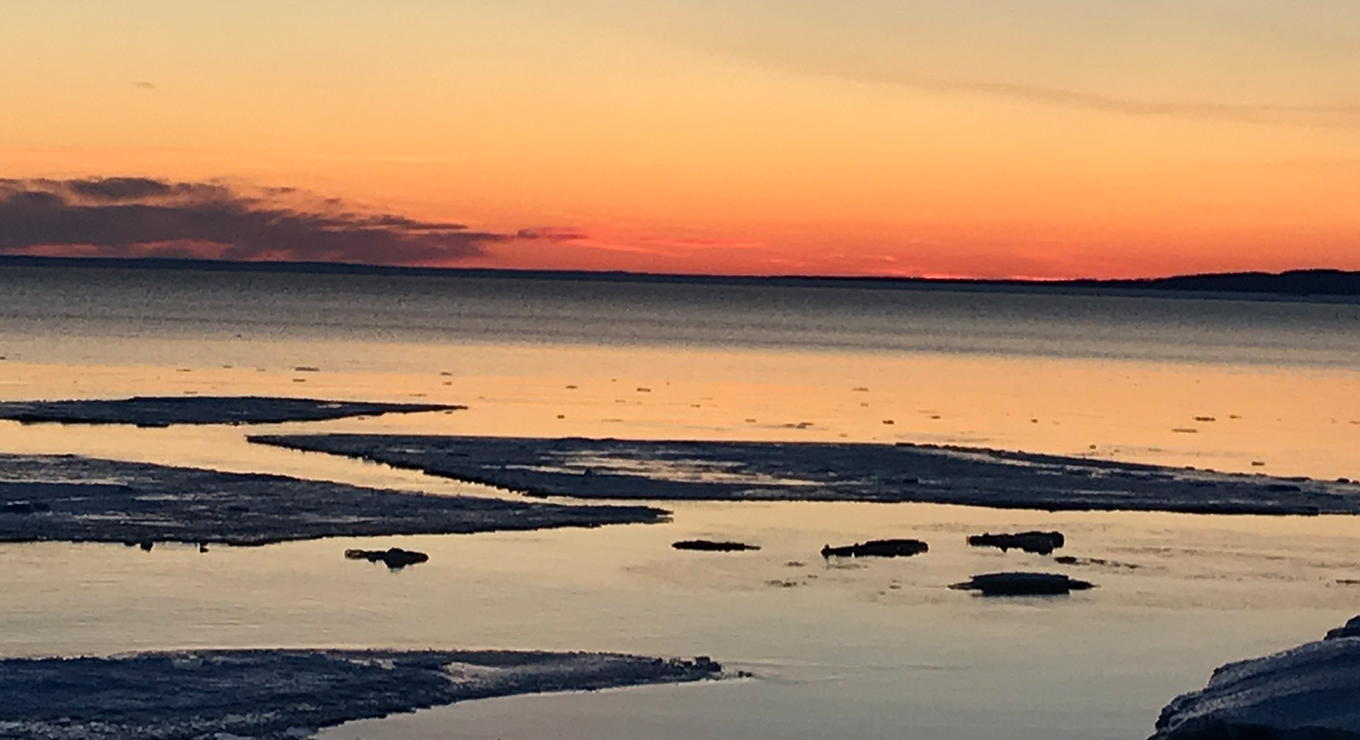
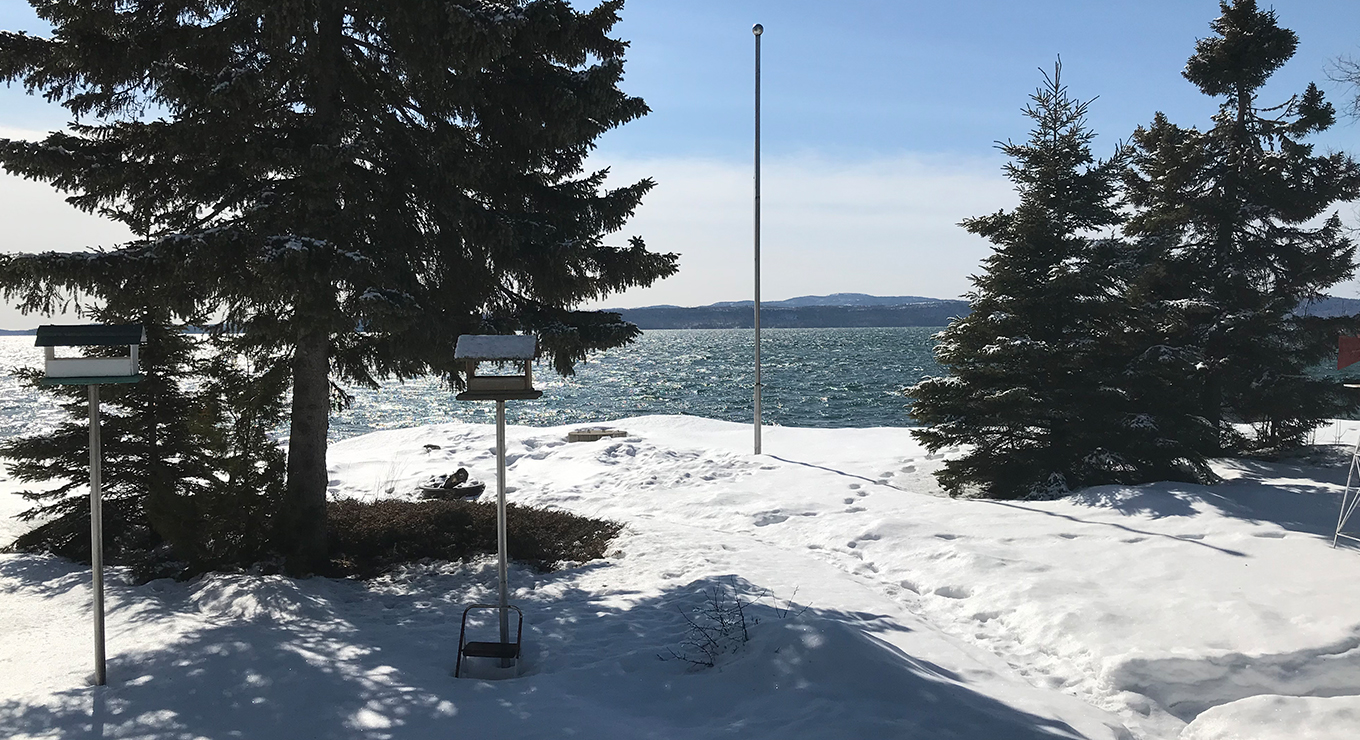
Nisichawayasihk Cree Nation, also referred to as Nelson House, is a warm, picturesque, and hospitable drive-in community in Northern Manitoba about 80 km West of Thompson. Vast skies and dense forests filled with spruce, tamarack, and birch trees stand tall and mysterious by the rivers’ shores. These rivers are so vast that they are often locally referred to as “lakes”. The first few things that struck us when I arrived here with my husband were the beautiful sunsets and skies painted in yellow, orange, pink, and purple as well as the mischievous ravens flying around our teacherages and new school. Friendly dogs were walking about, greeting us in their own way, and wagging their tails happily.
A lakeside sunset with purple, pink, and orange skies.
Leaving the City Life
I am of European descent – a Canadian educator with Central and Eastern European roots; my husband Matteo is new to the country, coming straight from Civitta Castellana near Rome, Italy. We were excited about our new journey and what was turning out to be a culturally enriching experience in the North. We had never before experienced a northern way of life, temperatures as low as -40, or seen the aurora borealis, also referred to as the northern lights. We were looking forward to safely encountering local animal life, as we did on our way to Nisichawayasihk Cree Nation. A cub jumped out on the road chasing a raven and later on we spotted a fox and two black bears.
Following our two weeks in isolation due to COVID-19 imposed restrictions for newcomers, we started exploring the community. We walked the gravel roads, enjoying the beautiful lake scenery all around. We walked on “Bay Road”, past the Three Rivers Store, and encountered many local people that were very friendly, eagerly greeting us, and curious to find out more about the “new teachers in town”. It was a new experience to encounter friendly faces greeting us all around town.
My husband and I were both used to living in large cities, where people were often in a hurry, preoccupied with their thoughts and daily commute routine. Hardly anyone notices your existence, let alone greets you or wants to find out more about you… well, unless you are entering a store to buy something. City life can be quite impersonal and dynamic. However, this is certainly not the case in Nisichawayasihk Cree Nation where everyone wants to know you and shares some banok, cranberry jam or traditional medicine to strengthen your immune system to fight off COVID-19 if needed. Local people are caring, love a good laugh, and enjoy passing on stories through wise and spiritual teachings.
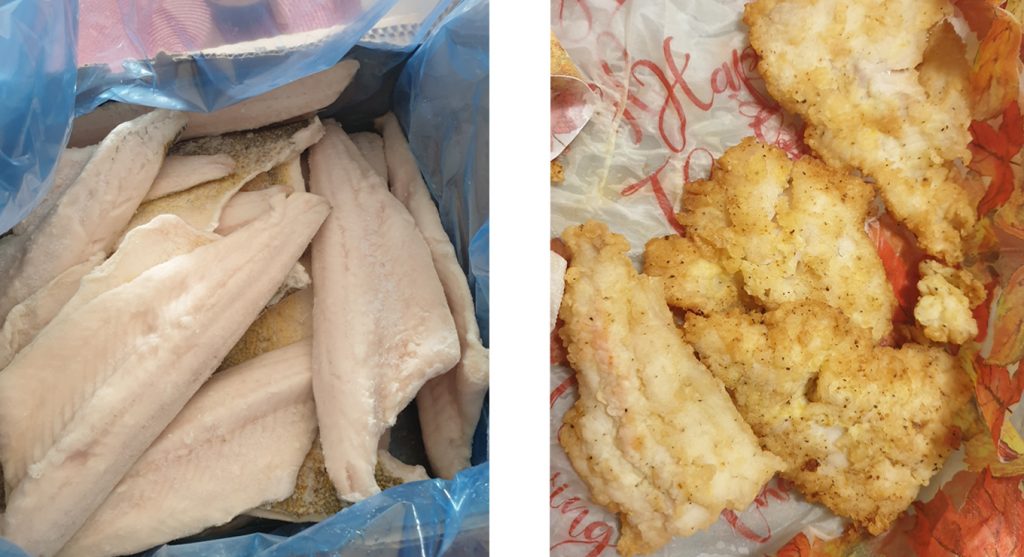
Freshly fried fish – another delicious local treat!
Understanding the Community and Culture
Local community members and Elders work very hard to preserve and revive the nîhithaw language and important cultural practices. This effort is becoming a reality through the joint work of Elders, Knowledge Keepers, community members, and organizations like the local Wellness Center and the Alice Moore Education Authority. I was greeted and welcomed as a new teacher to both facilities where I received a wealth of information about the history and language and was given a Nisicawayasihk Rocky Cree wordlist book to help with my future work with local children.
The Grandma and Grandpa cabin activities at the Otetiskwin Elementary School teach children about the local culture through woodwork and craft making. This is where I made my first dream catcher and learned the beginnings of beading. Students also attend Cree language classes at the school and teachers are welcome to learn with them from a team of experienced, loving, and wise Cree language educators.
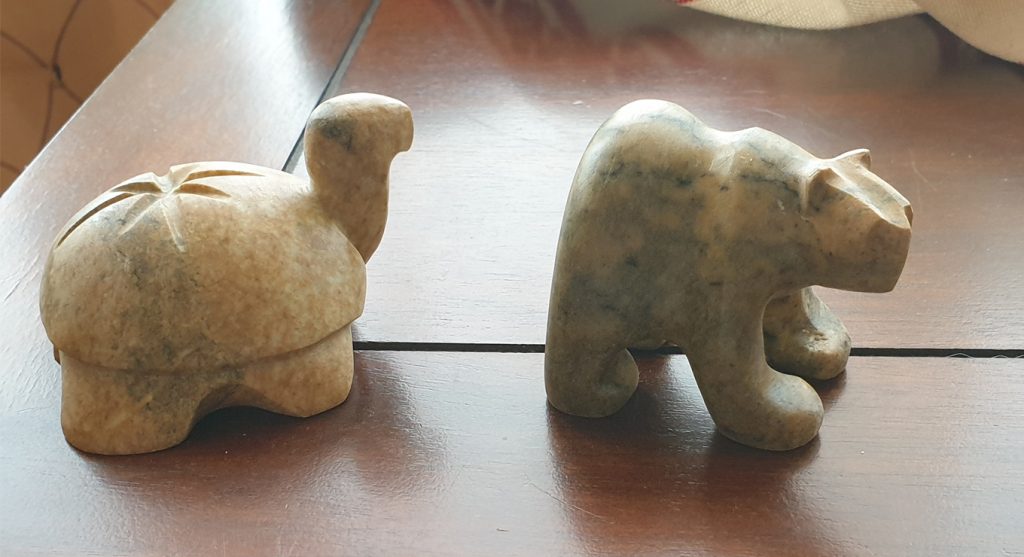
Beatrix was able to view and enjoy local art such as these soap stone carvings of a turtle and bear.
What it Means to Live in the North
“Living in the North means being ready to embrace the local culture, ask questions, spend as much time as possible outdoors, and meet new people.”
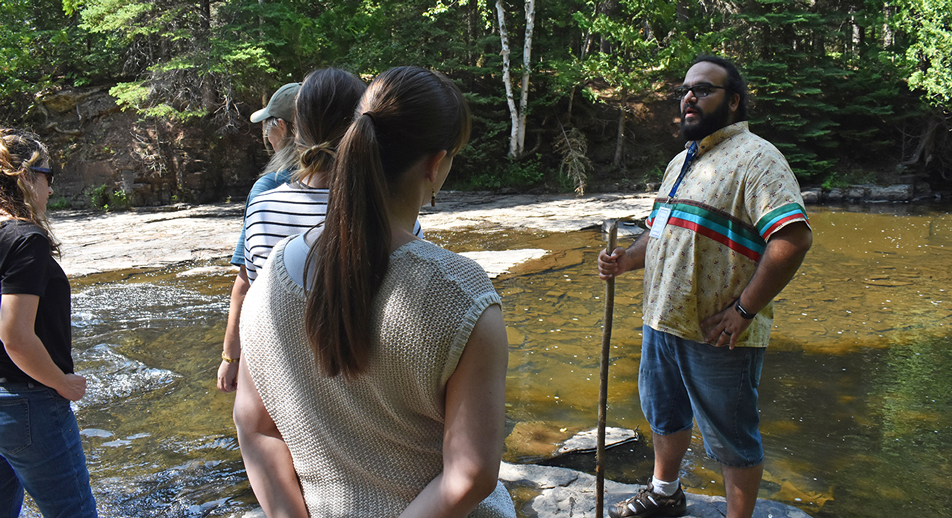
We were fortunate enough to experience some cultural activities such as: banok making, cooking moose stew on the campfire, listening to local stories of the history and language preservation (Rocky Cree dialect), viewing local arts and crafts like beadwork and soap stone carvings, as well as fishing and moose hunting with a local guide. As I am writing this, I look forward to taking part in a ceremony in the local sweat lodge, where we were warmly greeted and welcomed with a smudge and a cultural tour of the facilities by the keeper.
The catch of the day – Beatrix was able to fish and hunt with a local guide.
At an unprecedented time where half of the world is in lockdown and crisis caused by COVID-19, we feel very safe and taken care of by the whole community and its leadership. At the time of writing this, we have no cases and everyone is working together to keep everyone safe. Being out in nature has been keeping everyone in good mental and physical health.
Nisichawayasihk Cree Nation has warmly embraced us, and so have we, on our journey to discovering the multitude of Indigenous cultural practices and languages that define this country and have for thousands of years before settlement. When I think of this community, I think of wisdom, family, friendship, ancestors, and spirituality. Living in the North means being ready to learn, respect, listen, and understand.
Teach For Canada’s Summer Enrichment Program brings teachers together with Indigenous leaders, northern teachers, and education experts to prepare them to support student success in northern First Nations in Ontario and Manitoba. This year, the Summer Enrichment Program was fully digitized in response to the pandemic. Bryan Bellefeuille is one presenter for the 2020 program, focusing on land-based education. We asked Bryan about what he hopes teachers will take away from his session.
Teach For Canada’s cornerstone Summer Enrichment Program prepares teachers to support student success in the North.
Bryan Bellefeuille – Land-based Learning
Bryan is the father of three and is Anishinaabe of Nipissing First Nation. He is a firekeeper, a grass dancer, and a traditional fisherman. Bryan graduated from the Schulich School of Education at Nipissing University after completing an undergraduate in Mathematics. During his time enrolled he was invited to speak at the Perimeter Institute for Theoretical Physics regarding Indigenous Mathematics, as well as attend a session of the same topic at the Fields Institute of Mathematical Sciences. Bryan is currently an Ojibwe Language Teacher on the North Shore of Lake Huron. He previously worked with Indigenous people within the Ontario and Canadian Criminal Justice System as a Gladue Report Writer. During that time Bryan was part of the team that edited the Ontario curriculum for Grade 10 History in response to the Truth and Reconciliation Commission’s Call to Actions numbers 62 & 63.
Bryan Beullefeuille leading a session on Indigenous mathematics with Teach For Canada teachers in 2019.
Tell us about the approach you are taking to engage teachers online during this session.
Attempting to teach land-based learning to a group of 50 learners over a Zoom session is a tricky task. Normally we would be outside feeling and smelling trees, we would be interacting with expected and unexpected events with nature. We should be learning the traditional way, which my family has done since time immemorial.
Having made some Ojibwe Language videos using clips from a video game, I decided to take a similar approach to my session. The core of my session will be guided by me live. There will be prerecorded real-life moments of me in natural settings to assist students in being grounded in the moment and understanding the processes that are occurring. There will be prerecorded video game moments, this will help recreate moments for students that would normally be in the bush. You can watch a highlight reel here.
Why is land-based learning so important to integrate into children’s education?
Land-based learning has countless benefits when educating children. Much research has been done under the term “outdoor experiential education”, and when we combine those researched benefits with the understanding that this land-based learning is knowledge being passed down for generations to these students, then we realize that the benefits become immeasurable.
What are you hoping teachers will take away from your session?
I am hoping that teachers understand that Indigenous people hold such powerful knowledge that it can save lives in a modern context. I want them to know that it is important to teach that their family knowledge is important and valuable. I want them to know that to make space for Traditional Knowledge in unconventionally thought subjects, like mathematics, is not only worth their time but can change the world through the future actions of those students.
If other teachers were interested in learning more about land-based learning, what would you suggest they do, read, or learn?
At the end of my session for the Teach For Canada teachers, I provided a small guide. It is difficult to be one person to teach land-based learning with Traditional Knowledge and teachings. The guide asks teachers questions like, “Who would know historical teachings about it?” and “What places have Indigenous Knowledge holders about this topic?”. I remind teachers to have tobacco ready to gift to any knowledge holders and I remind them that information you learn from Traditional Knowledge holders may be sacred, which means you should not distribute it without its traditional context or permission from the teacher.
Traditional Indigenous Mathematics is a great place to start. Math in a cultural context was examined and written into books that teachers can use as a resource. Here’s an example. I myself would love to create a book for my own peoples and teachings.
Albee Eisbrenner has been teaching high school physical education and math through the Keewaytinook Internet High School (KiHS) while based in North Spirit Lake First Nation, Keewaywin First Nation, and Kitchenuhmaykoosib Inninuwugthrough Teach For Canada over the last two years. Since he was evacuated due to COVID-19 he’s been teaching remotely from Winnipeg. Read on to hear about Albee’s experiences teaching online, how COVID-19 has changed things, and the advice he has for northern teachers taking on virtual learning.
Teach For Canada teacher Albee has been teaching through KiHSfor the last two years.
In some ways I feel like northern educators have had a head start when it comes to the isolation we’ve been experiencing during COVID-19. We’ve already had to learn how to build strategies to stay healthy and well. I was evacuated out of the community and I’m living in Winnipeg now, and it still feels very much like I’m in the North as far as being able to see family and friends and having limited access to services and recreation. The one thing that is different is that I can’t see my students, which has been hard.
Albee built strategies on how to stay healthy and well as a northern teacher.
I have worked through the Keewaytinook Internet High School (KiHS) since 2018. We connect students with resources to succeed at school when they would have otherwise been left behind. I’ve also been working as a graduation coach to help connect students to post-secondary options. One of the biggest strengths of our program was that we have a certified teacher in each community to help guide learning. Being evacuated has made it a lot more challenging because we’re no longer able to directly facilitate content with our students.
Teaching remotely during COVID-19 has been more difficult for Albee without directly facilitating content with students.
I chose to teach through KiHS because they allowed me to teach my qualifications of mathematics and physical and health education. This allowed me to teach but stay in a northern community and still be connected to a whole team of high school teachers. An added benefit now has been the experience I’ve had with distance learning and education. No one could have predicted how these events turned out but it’s become a very valuable skill to have.
It’s also been a smoother transition for our students. It’s a unique situation because we already have the support for distance learning and we can continue to operate. It did change how we approach students and the community, however. We’ve offered to take on additional students from other communities who have returned home to quarantine with their families. We’ve also opened up programming for Grade 7/8 for schools that stopped operating altogether. We’ve all pulled together to make it happen.
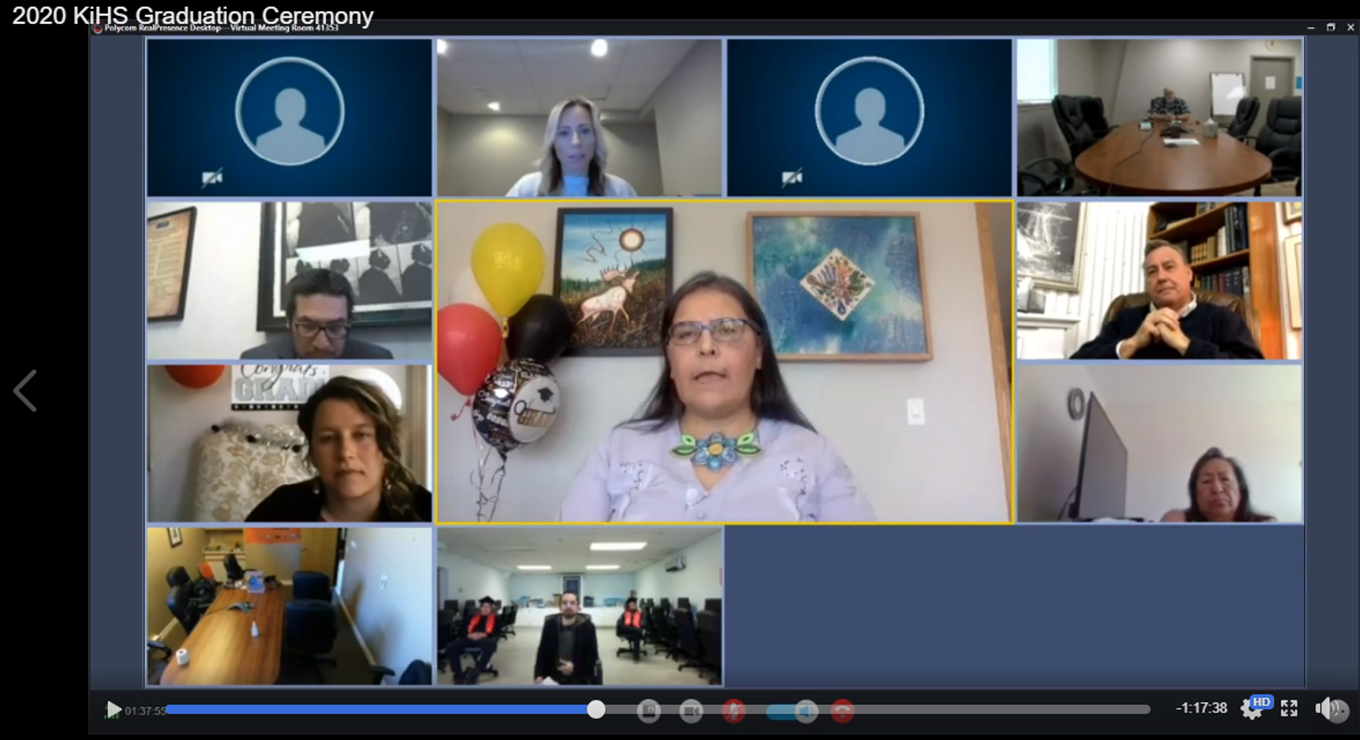
KiHS hosted its first-ever fully virtual graduation ceremony this year.
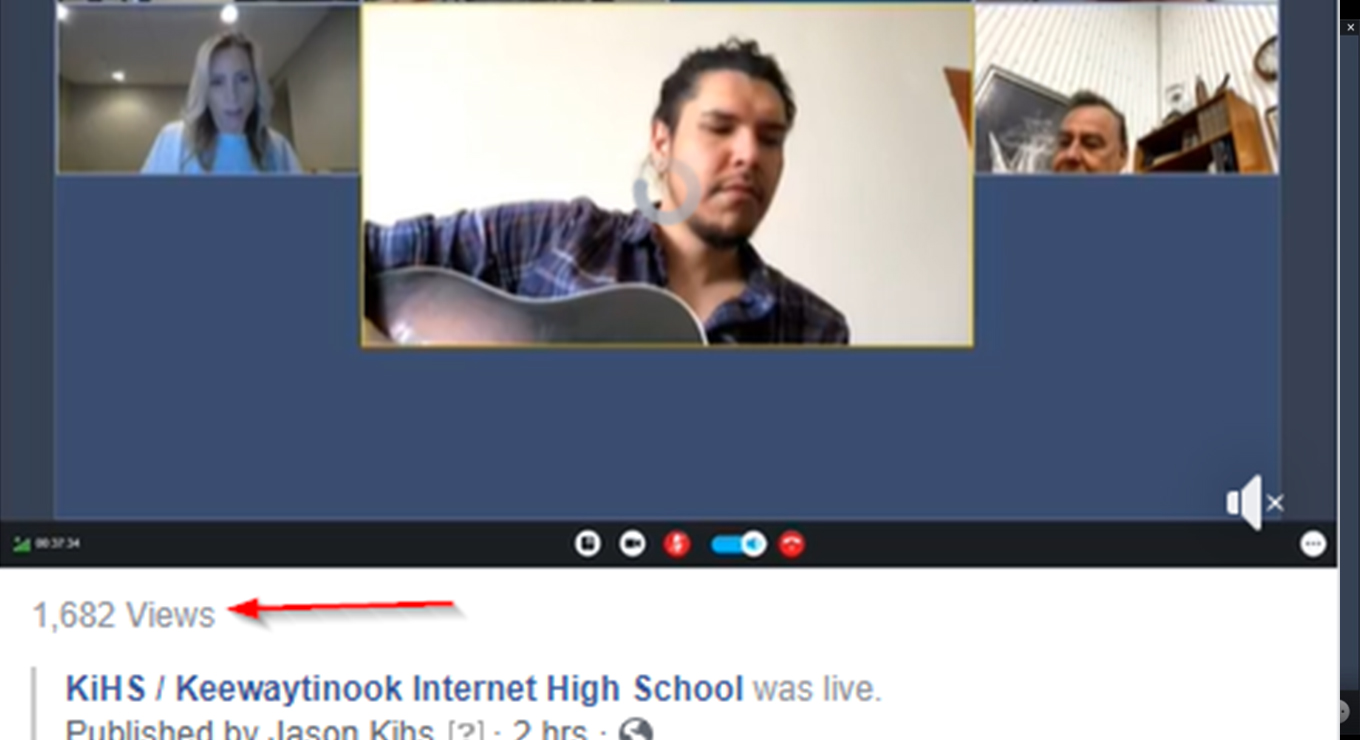
We’ve “embraced the strange” this year. We hosted our first fully virtual graduation ceremony on May 20th. Components of our graduation ceremonies in the past were online but this year we had to get really creative. We used a mixture of pre-recorded and live content and created a virtual procession for each student. We had live performances, a keynote speaker, awards, and a valedictorian speech. We invited other schools to join us to see what an online graduation ceremony could look like. It was a really special moment for the students, their families, and their teachers. You can watch the recording here.
The virtual graduation ceremony had a huge turnout with over 1,500 people tuning in to celebrate the graduates.
As for next year, no one knows what it is going to look like. I’m doing everything I can to set myself up and I hope that it’ll work out. I’m a planner so it’s a tough one. But if not, there’s always a plan B, or a plan C to realize my goals.
Albee knows the school year might look different this year but he’s confident he’ll find a way to achieve his goals.
Here is some advice for northern teachers who might be taking on online learning for the first time: Get on Facebook
Every single student and community member I’ve met has Facebook. So, if you need to get a hold of someone you need to get on Facebook. Two years ago Teach For Canada told my cohort of teachers to get professional Facebook accounts and it’s been the central communication method I’ve used since coming North. We have a Facebook group with all of the students’ families to engage with the learning. We even do roll calls on it. Facebook for me has been an excellent educational tool.
Be innovative, don’t just be a passenger
I’ve been lucky that we’ve had a platform and a scheduling framework to follow when building online content. It’d be hard to do it alone. You’ll need to work with whatever framework your institution is setting up. Follow what they’ve outlined, but be innovative and build on that. This is the time where you can stand out and showcase what you learned in college and apply it online.
Connect meaningfully with your students
I suggest reaching out to your students individually at the start of each week to see how they are doing physically and mentally. Ask them how their weekend was. And then connect them to any support they might need that week like a wellness coordinator or a guidance counsellor. It’s important to form that genuine connection and make sure they know you value them as a person before you even mention school work. From there, you can keep tabs on them and see what their goals are for this week, how their progress has been, and talk about accountability. Their health and wellness should be the first priority, and their education will follow.
Support differentiated learning online
Online programming won’t be the same for every student, just like in the classroom. You should be working with your students and give them the freedom to identify their own personal goals and to make sure their projects match their interests. You can also use different mediums for instruction like videos and other kinds of content. Beyond that, it’s also important to integrate community-based activities into your lesson plan and to build those connections. Hunting, fishing, collecting wood, and clearing trails are all physically demanding work and many of my students are already doing that for their families and communities. So we talk about how that is building your muscles and its benefits for physical activity.
Take care of yourself
We learned a lot at Teach For Canada’s Summer Enrichment Program about how to keep yourself healthy and well in the North. Northern teachers have great ideas on how to maintain health during times of isolation because that is what we live. Find some strategies that work for you that help to support the four dimensions of health: physical, social, emotional, and spiritual. It’ll help you embrace this strange time.
Interested in teaching in a northern First Nation? Apply by June 1st for the 2020/2021 school year. Questions about how COVID-19 will impact the process? Read our FAQ.
With many children spending more time at home across the country, we asked Teach For Canada’s team of experienced northern educators to share their favourite activities that can easily be done with family. From making art to spending time in the outdoors together – there are a lot of ways you can spend meaningful time with your children while practicing social distancing. Read on for some great ideas and inspiration!
Get Outside! – Karissa Frey, Teacher Development Manager
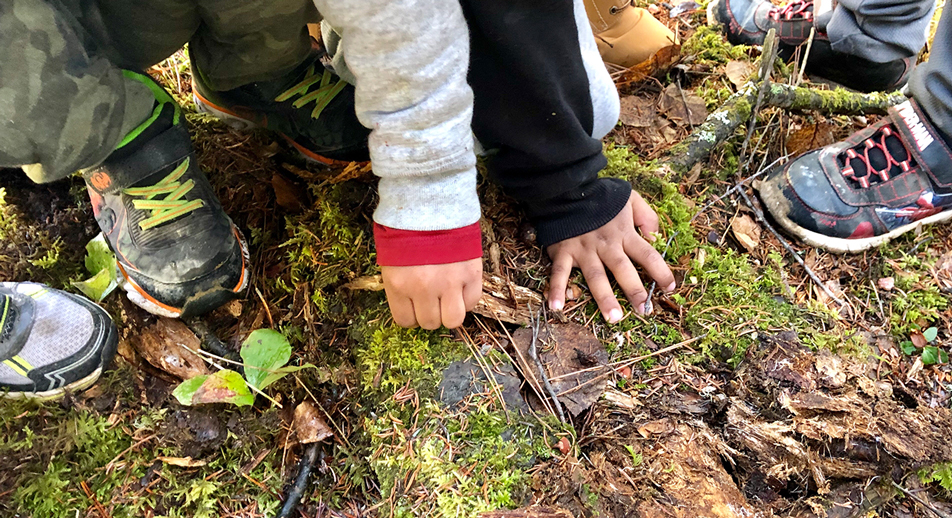
While many of us are feeling the effects of being cooped up inside, I love to find ways to get outdoors while still staying safe and practicing social distancing. There are so many different ways that you can take advantage of the warming weather and natural environment during this season.
Outdoor Art
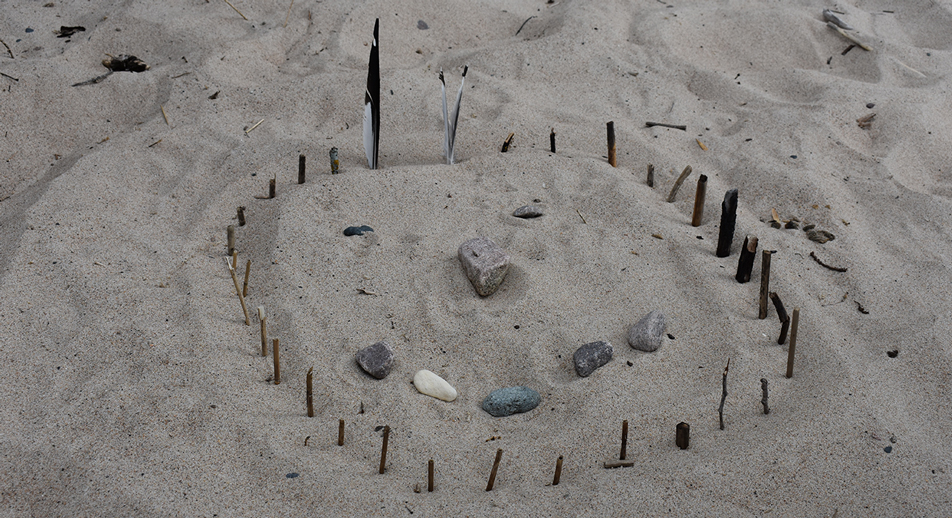
Encourage your child to explore their natural environment by creating a piece of art using only natural materials. You can take a walk or even look in your backyard for anything that could be made to create a piece. This could be a sculpture, a picture – anything at all really! The only rule is that you must not disturb any living things. After the piece has been created, have your child tell you about the process they used to create it – and see if there may be a story to accompany it.
This is an example of outdoor art using items you can find in the natural environment.
Scavenger Hunt
Another great outdoor activity is a simple scavenger hunt. You can do it with photos, drawings, or any other creative way you want! Create a list of things for your child to find, and then take a walk to see which of the items you can spot. Some ideas include:
– A tree taller than yourself
– Something rough
– Something purple
– Something wet
– Something that’s fallen from a tree
– Something tiny
– Something huge
Scavenger hunts can be done in your own backyard or on a walk down your sidewalk.
Feel free to create your own, or use one of the many premade hunts you can find online. I like this one from Buggy and Buddy for younger children, and this one from Love the Outdoors for older children, or if you are in a more rural area. No matter what activity you do, providing any opportunities for outdoor free play can have positive effects and be a great way to spend time as a family!
Spend Time Together Enjoying Books! – Nicole Nuk, Director of Teacher Development
One of the most important ways you can use this extra time at home with your kids is by spending time together. Yes, there can always be academic goals to focus on. Yes, there are always chores around the house you could get your kids to tackle. But spending time together without specific goals in mind will be the moments you, and your kids, will remember most vividly from this unique time in our lives.
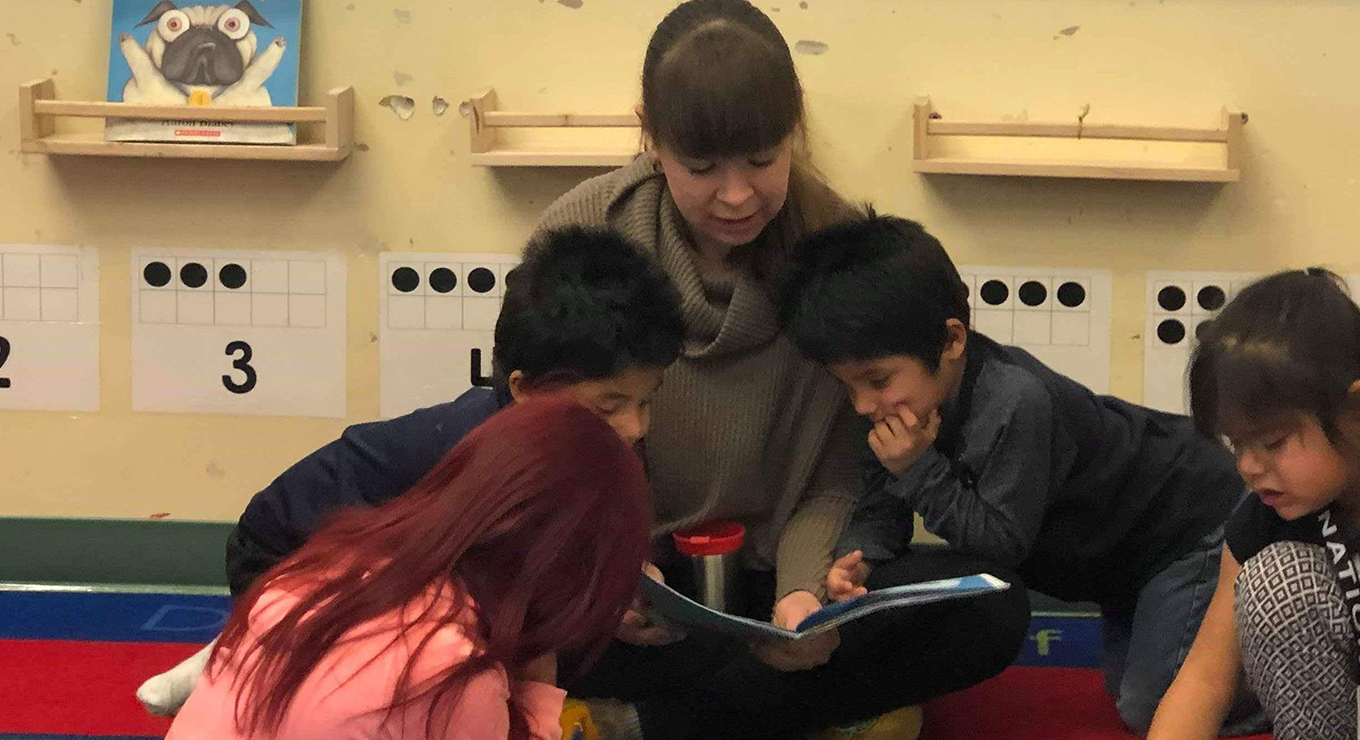
So… try reading together!
There are a lot of online resources to find books to suit your child’s reading level.
You can read to your child:
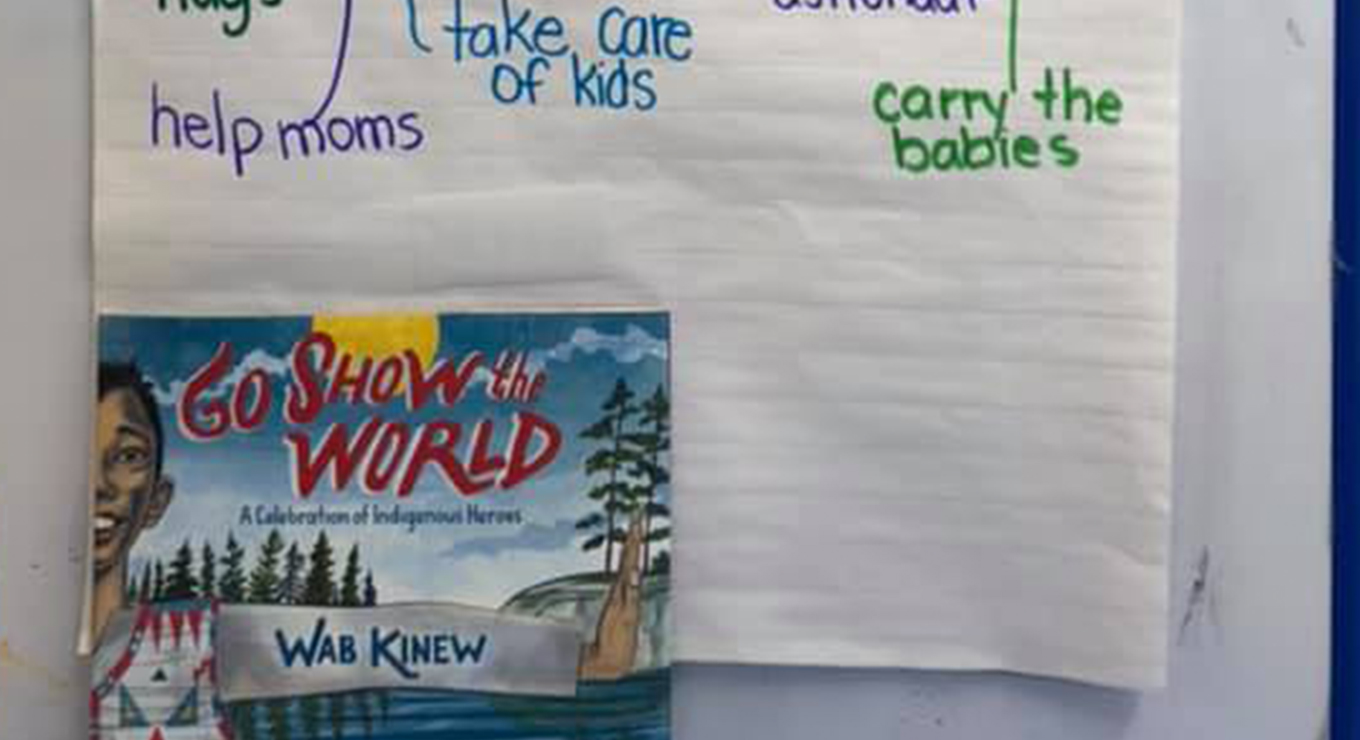
If you have books around the house that is the best place to start! If you are looking to add to your library, try a small independent book store like Goodminds where you’ll find First Nations, Metis and Inuit culturally appropriate educational resources and products.
You can find First Nations, Metis and Inuit culturally appropriate educational resources.
Your child can read to you:
There are many online book libraries that are full of titles to engage your young reader. Raz-Kids provides levelled books to suit your child’s reading level and is offering free access during school closures. Epic! is an extensive online book catalogue with lots of popular titles and interesting topics. If you’d like to add some more depth to your time reading with your kids, try ReadWorks – a vast online reading library that also has a reading comprehension focus. Scholastic has also put out some great daily reading-focused activities to take your reading time to the next level.
You don’t always have to do the reading. Listening to someone else read is a relaxing way to keep books alive!
You can listen to someone else read aloud:
If you need an extra break, listening to someone else read is a relaxing way to keep books alive in your house. Audible, a collection of online audiobooks, has made a promise to wave their subscription fee as long as schools are closed. Storyline Online has a great video collection of celebrated actors reading engaging books. For more information on how to make the most of this time with your kids check out Why it’s important to read aloud with your kids, and how to make it count. Happy reading!
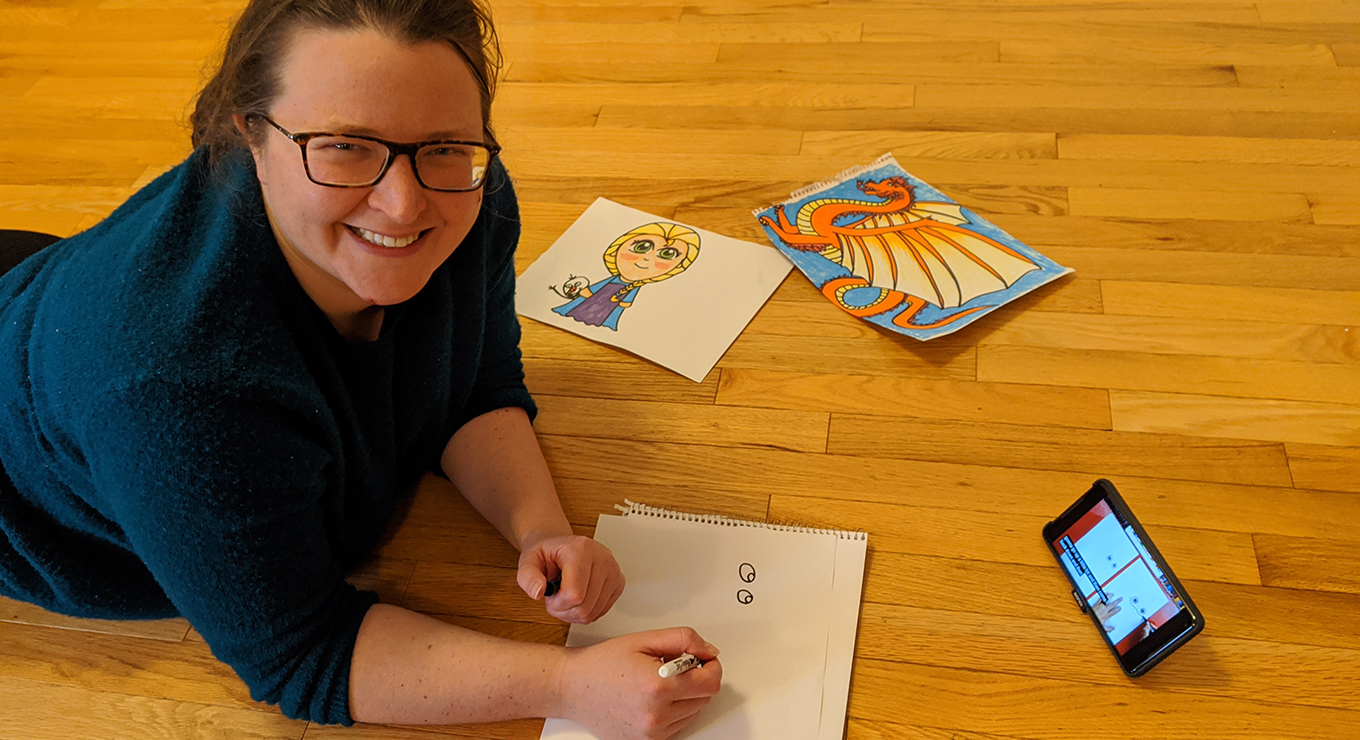
One activity I’ve been really enjoying over the past few weeks is guided drawing. I’ve never been particularly artistic and we don’t keep lots of art supplies around the house, but with self-isolation looming, screen time expanding, and boredom creeping in, I decided it was time to get creative. That’s when I stumbled across the idea of guided drawing. Basically, you watch a short video of a professional illustrator drawing a picture step by step, and you follow along doing what they do.
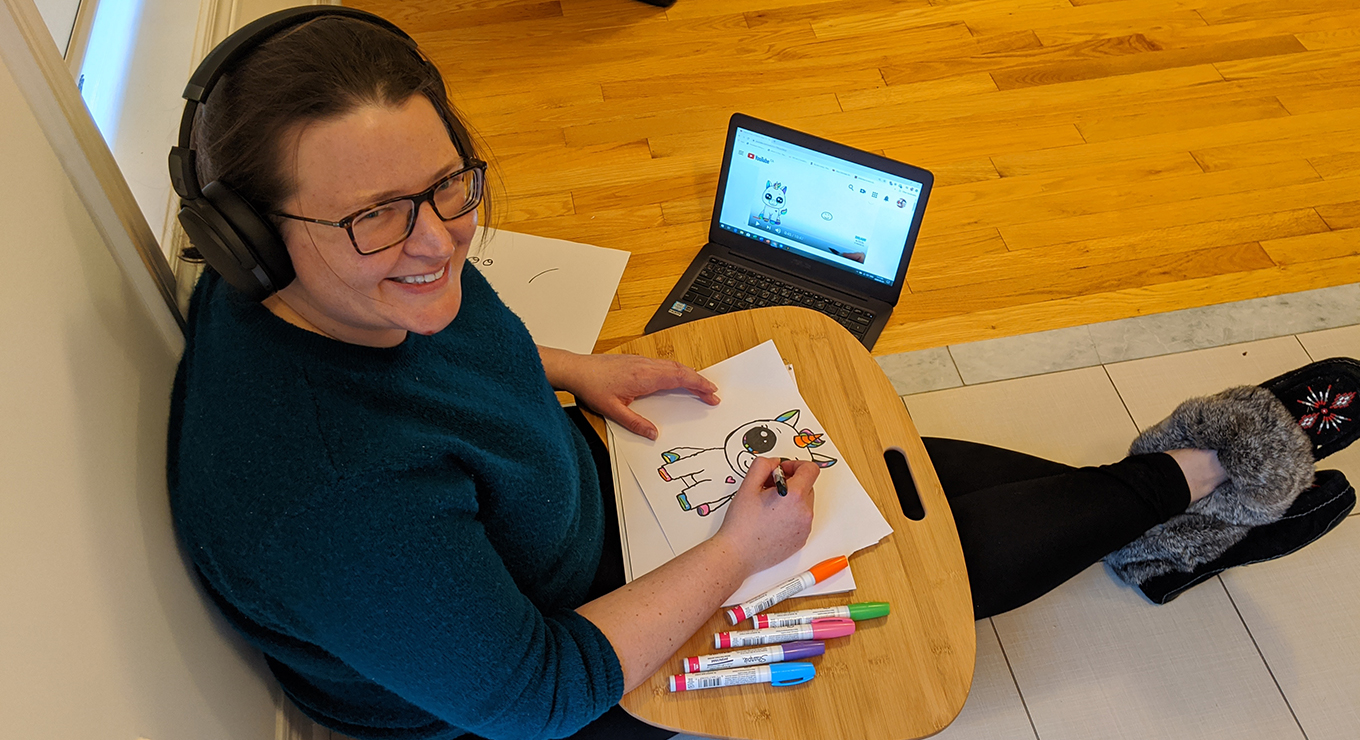
Nicole has been using online resources to guide her drawing.
It’s super easy, requiring no planning and minimal supplies. All you need is paper, something to draw with, colours, and a screen that connects to YouTube. It’s also very flexible. I’ve been enjoying drawing by myself and with my partner. Similarly, kids can easily draw solo, work together in small groups, with a parent, or try drawing with the whole family!
You can find videos with different difficulty levels and styles.
There are tons of great videos online with all sorts of different difficulty levels, styles, and things to draw. My favourite so far are by Art Hub For Kids. They have an amateur artist (often a kid) draw alongside the professional illustrator. Plus the instructions are very clear and kid-friendly. I also highly recommend Lunch Doodle with Mo Willems. He’s the author of lots of awesome and very funny picture books like, “Don’t Let The Pigeon Drive the Bus!” and “We Are in a Book!” and helps kids recreate his most popular characters.
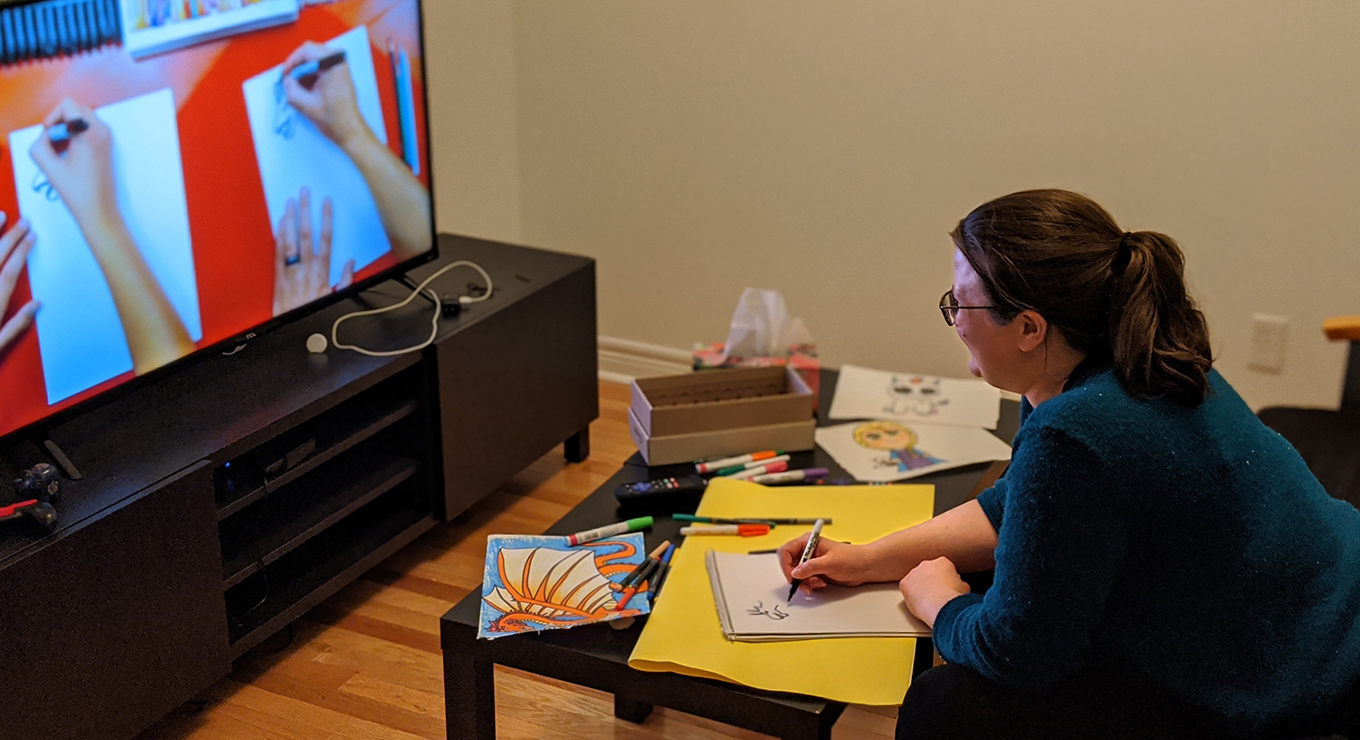
Nicole finds drawing grounding and has seen her drawing skills improve.
The number one reason to try guided drawing is that it’s really fun. I’ve started doing a guided drawing every day because, for a half-hour, while I draw, I forget about everything but the picture on the page. I’m totally engrossed, engaged, and focused. And I’m actually getting better at drawing. Kids, if they are anything like me, will emerge from this activity a little more grounded, a little less stressed, and with a picture they can be proud of. So get guided drawing and add some art to your day!
Dance Movement! – Anikka Bolender, Teacher Development Manager
What do Tom Cruise, the Jonas Brothers, and the Wiggles all have in common? Dancing in the living room! I am by no means a “good dancer” – I wouldn’t even call myself mediocre. Yet, when certain songs come on I can’t help but find myself bopping along to the tune and eventually breaking out into full-on dancing.
My previous students can also attest to my love of dancing. Dancing in the classroom, taking turns having students lead our group in a favourite dance move became a very popular end of the day or brain-break activity. Not only was dancing a great way to promote physical activity but it built community and trust in the classroom — getting silly and showing off that new dance move was encouraged!
Dancing can be a good body and brain break!
In the last few weeks, dancing in my kitchen and living room has been a fun, energizing break during my workday! Not only has bouncing around the room, often accompanied by my cat, given me a much needed break from staring at a screen but also made me laugh and brought a smile to my face. The Just Dance channel on Youtube has been my go-to for music and the videos have dance moves you can follow along to. Kidz Bop has very kid-friendly music and instructional videos that break down their dances into easy to follow steps. Both are great resources to get you and your family dancing!
You can find instructional videos online that break down their dances into easy steps to follow.
Dancing is an everyone activity, it’s universal, and it’s found all around the world! Try exploring the world with your family through dance and music! Interested in learning about First Nations dance styles? Keep a lookout for videos of jingle dancers dancing on their front porches to share healing and joy, like this one. The website All Around This World has a huge bank of resources that explore world cultures and music. Learn about the Haka, the traditional dance of the Maori people of what is now New Zealand, check out the link found here. Or try learning the Latin style dance of Salsa in a Five(Ish) Minute Dance Lesson video produced by John F. Kennedy Center for the Performing Arts. Take a few minutes and dance today, I guarantee it will leave a smile on your face!
Write What You See – Dan MacDonald, Teacher Development Manager
Writing confidently can be a challenge for some students, and the best way to overcome that challenge is to work on it and practice writing skills. Descriptive writing is a great way to move away from surface-level writing and move into deeper, more engaging writing. This will help students who want to improve their writing ability and will really come in useful when they are writing essays because it trains them to look deeper and think about what they’re saying.
These are a series of photos Dan has used in ‘Write What You See” activities.
One of the easiest ways to practice descriptive writing includes two of my favourite things: spending time outside and reflecting. Spending time outside has its own rewards and can help kids ground and calm themselves. Reflecting on how you feel and what you’re thinking also has rewards—particularly by helping kids increase their emotional literacy (being able to talk and think about how they feel and what is making them feel that way). Reflection and emotional literacy are life skills that help academically, but also help kids grow their ability to be thoughtful.
In this exercise, you write about what you see, hear, feel, smell, and think.
Here’s how it works:
Grab some paper and a pencil or a pen
Go outside and get comfortable!
Write about what you see, hear, feel, smell, and think
Use sentence starters to get going
I can smell…
I can hear…
It sounds like…
I see…
This makes me feel…
It reminds me of…
When I see _______ it makes me think…
Share what you wrote with an adult or another child and discuss
There are no wrong answers in descriptive writing.
The nice thing about this kind of work is that there are no stakes. By that, I mean that the kids can grow their confidence since there are no wrong answers. As a parent, guardian, or teacher, it is really valuable to praise the child that is working on their descriptive writing.
You can help encourage your children by praising their descriptive writing and prompting with more questions.
You might be wondering: “How can I help my child improve their descriptive writing?” This is also really simple! Just praise their observations and willingness to try this activity. Then ask questions to see if they can go deeper in their writing. Some questions might include the following:
What else do you hear? What else do you see? What else do you feel or think?
Does this sound/smell/sight make you think of anything else?
What is the first thing that you noticed when you came outside?
Do you feel better or worse when you’re outside?
Can you write one sentence that includes something you see and something you hear?
Here’s an example of descriptive writing. You can’t go wrong if you ask any questions, but the ones above are a good starting point if you aren’t sure what to ask. This kind of activity is really simple and has a lot of rewards. Give it a try!
Dr. Cynthia Wesley-Esquimaux presented on Strategies for Teaching First Nations Students in the North on March 10th and March 25th 2020 as free professional development opportunities for teachers through Teach For Canada. Dr. Wesley-Esquimaux served as Vice Provost for Aboriginal Initiatives at Lakehead University for three years and was appointed as the first Indigenous Chair for Truth and Reconciliation in Canada. She continues to develop pathways forward to reconciliation in Canada. She currently serves on Teach For Canada’s Board of Directors.
Read on for Dr. Wesley-Esquimaux’s four strategies for teaching in the North:
Looking East: Embedding “Wise Practices” in northern teaching experiences
Northern communities have a lot to offer. The environment is beautiful, you can spend a lot of time out on the land, and the people are very welcoming. If you choose to go North to teach, it’ll be important to get involved in the community, be open to others, and use humour. People may tease you – but it’s usually a sign that they are happy to have you there.
It will also be important to embed wise practices into your northern teaching experience. Wise practices are not the same as best practices because they are place-based and tied to culture – they cannot simply be applied elsewhere. Wise practices are practices that communities have been using forever, and they are now coming back and being used to strengthen communities, schools, and businesses.
Through my work with Brian Calliou and others at the Banff Centre we identified seven wise practices:
1. Identity and culture
2. Leadership
3. Strategic vision and planning
4. Good governance and management
5. Accountability and stewardship
6. Performance evaluation
7. Collaborations, partnerships, and external relationships
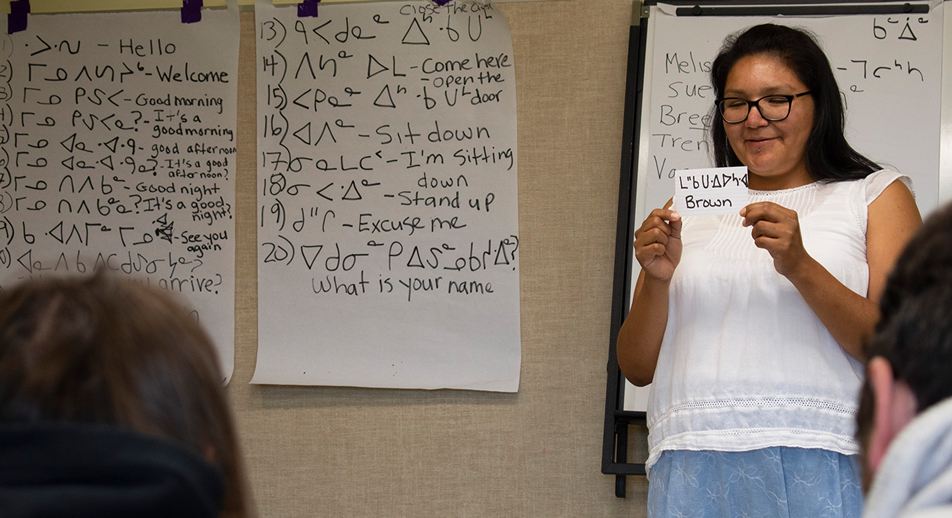
Coleen Moonias teaches Oji-Cree to Teach For Canada teachers at the Summer Enrichment Program of 2019.
While I won’t explain all of them here (click here if you’d like to learn more), you should know that the restoration of language and culture came out on top as number one. It is very important to First Nations communities and a lot of work on this is already happening.
That is why teaching in the North needs to be a reciprocal arrangement between equals. We both have something to learn from each other. It will change your life to learn about First Nations cultures, languages, traditions, and practices.
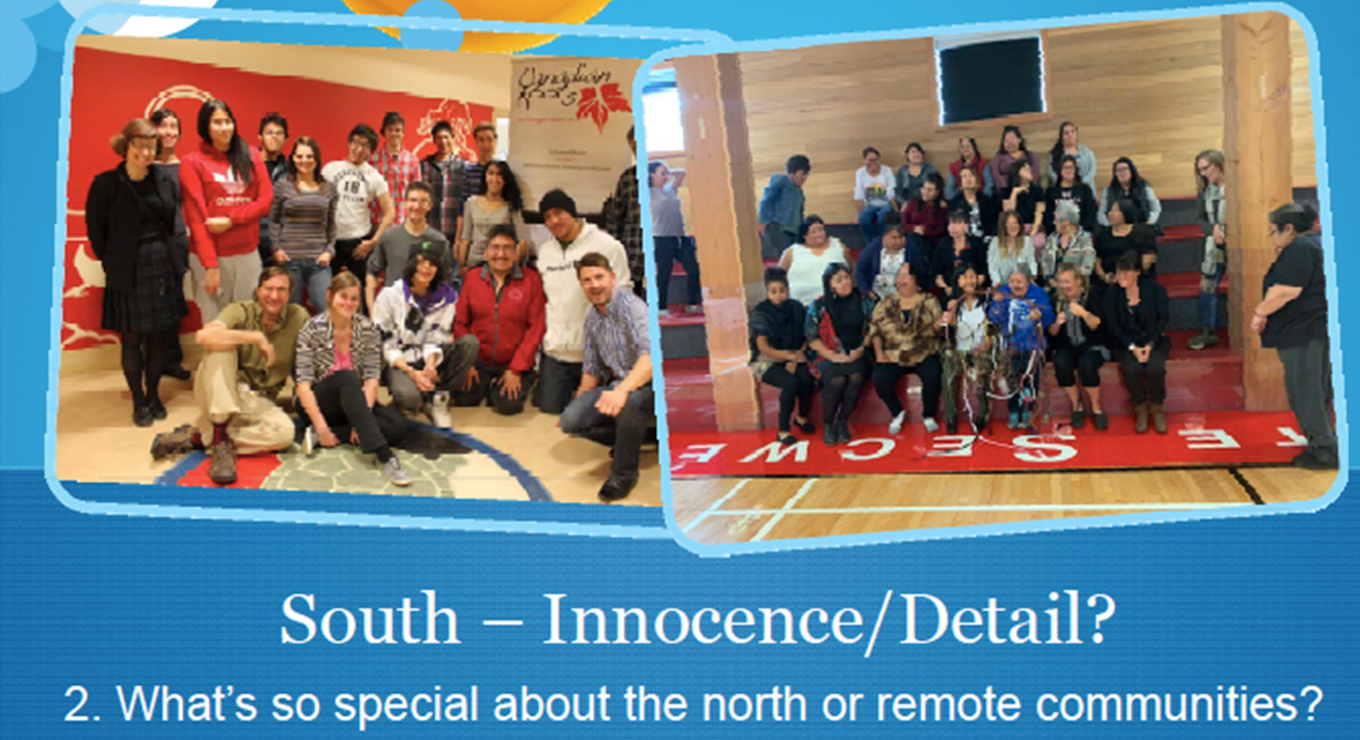
Looking South: What’s so special about the North or remote communities?
One thing that makes northern communities special is that the government has spent a long time trying to monitor and control them. Indigenous communities have been seen as something to get rid of because they stand in the way of development and resources. Government policies destroy peoples’ ability to make a living where they are and it’s become a big challenge for a lot of people to support themselves.
This has led to a lot of isolation and poverty. Poverty impacts families and creates tension in the community. And now we are seeing a repeat of the 60’s Scoop with the Millennial Scoop by the child welfare system. 52 percent of children in foster care are Indigenous, but they account for 7.7 percent of the overall child population under age 14 in Canada.
What is happening now is that young people are joining together to change what is happening in the North. They are looking to understand what happened and how they can start to fix it. Quite often young people are the ones who will inform you the most about the work that you’re doing as a teacher. Make sure you listen carefully.
Looking West: Why does history matter?
History matters because it resonates into the present. There is a very complex relationship between Indigenous people and the rest of Canadians. And we know that if we don’t pay attention to history, we are doomed to repeat it.
Working in education you will have to reconcile the past of residential schools and the present education system. A lot of children will have been affected by the experiences of their parents and grandparents who may have been in residential schools. The trauma of those experiences is quite often passed down. Children have also experienced loss from teachers departing and it can be hard work for teachers to gain the trust back of children. Your ability to have empathy for the things that you’ll be seeing and learning about will help you do your job well.
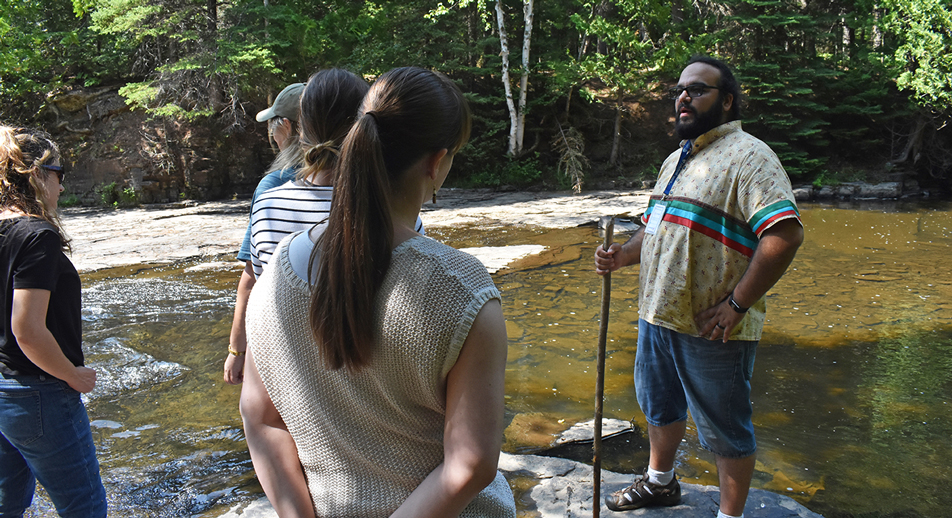
Bryan Bellefeuille leads a session on Indigenous mathematics at the Summer Enrichment Program of 2019.
As a teacher, you will need to learn about and show respect for the contributions of Indigenous Peoples such as the concept of democracy, our languages, clothing, place names, medicines, holistic systems, and the value of stories.
You will also be asked to tell your own story. When you go into a First Nation community people will want to know who you are, what your worldview is, and what the creation stories are where you come from. You should encourage your students to tell their stories too.
Looking North: What does success look like, feel like, and walk like in the north?
In a western model, success in education looks like a specific thing: getting “A” grades. In a northern community, it is different. It’s not that communities don’t want their children to get good grades, they also want you to appreciate their other abilities too. Maybe it is their skills in music, or their knowledge of plants and animals, or their work on their family trap lines.
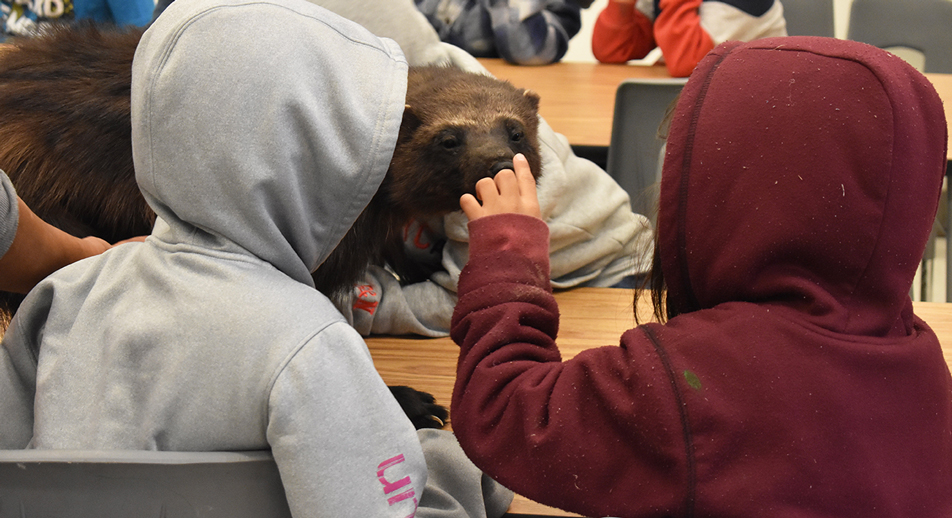
Grade 3 students in Pikangikum First Nation learn about trapping wolverines in an Elders’ classroom.
To be a successful teacher, it will be important to learn and understand the community’s policies and protocols. People will either tell you or you can learn through observation. You should know how to behave around Elders and always be sure to greet them and listen to them. You should also understand the governance structures in the community.
The greatest thing you can do when you go to a northern community is to get involved. Show up and be there, especially in times of tragedy. If you get invited to go out fishing, then go. You will learn from whoever takes you out, you will learn about yourself, and you will learn about the environment.
Teachers can play a big role in closing the education gap for First Nations youth. We don’t expect you as teachers to fix anything but just simply to be open and engage with community. Get to know Elders, young people, and Chief and Council to open this conversation in a good way. Open yourself to the experience and really live it.